
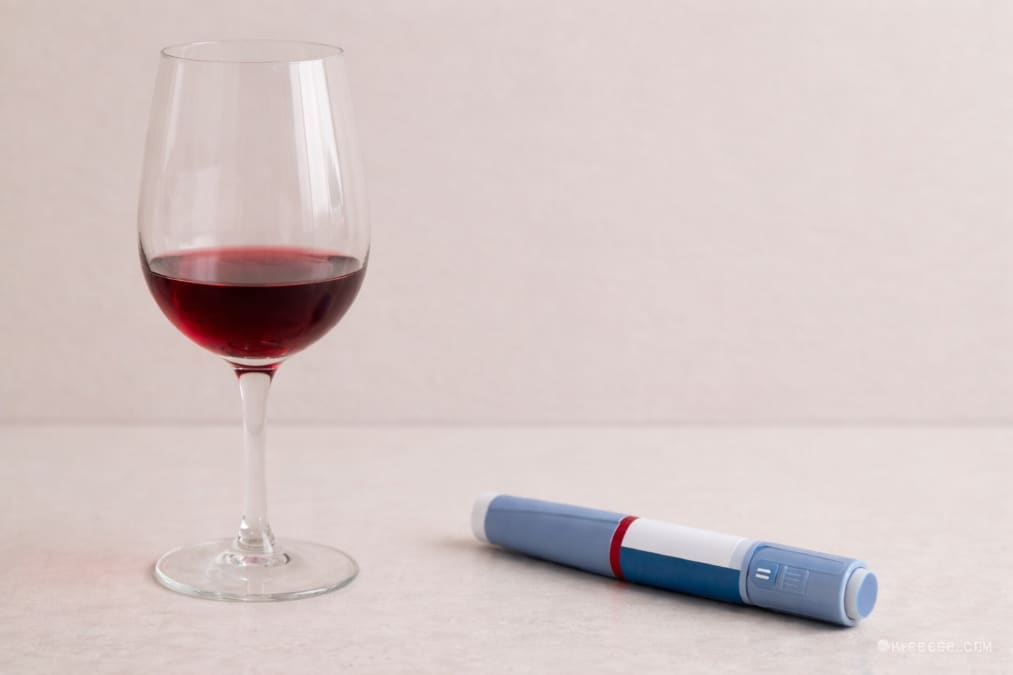
What Ozempic and related drugs do to alcohol, cravings, and reward
It’s happening more and more often, though it’s rarely spoken about out loud. People using Ozempic, or a related drug, find that their glass of wine stays half full. Not out of principle. Not out of guilt. But simply because they have less of an appetite. Because it affects them less. Because the glass of wine is less appealing.
That raises an intriguing question: does a diet shot also make you more sober? And if so, what does that say about alcohol, our brains, and how relative “craving” actually is?
Initial clinical studies suggest that drugs in the so-called GLP-1 class—originally developed for diabetes and obesity—do more than just curb appetite. They also appear to alter how alcohol is absorbed into our bodies and how we experience it. The effect is subtle, but the potential is significant: less urge to drink, less desire for reward, simply less desire to continue drinking.
That sounds promising. But it also raises questions. When is this a useful side effect, and when are we unknowingly sliding towards chemical and medical behavioural control?
From appetite to alcohol craving
GLP-1 agonists are medications that mimic the natural satiety hormone GLP-1. A well-known example is semaglutide, known from Ozempic and Wegovy. These drugs delay gastric emptying, increase the feeling of satiety, and influence brain areas related to reward and self-control.
The link with alcohol initially emerged not from large medical studies, but from observations. Doctors and researchers observed that patients taking GLP-1 medication spontaneously consumed less alcohol. Similar experiences appeared on social media: “I forget my glass,” “I’m no longer craving wine,” “I’ll stop after one.”
These signals prompted more targeted research.
What does controlled research show?
The pilot study, published in Scientific Reports, investigated how people with obesity experience alcohol when taking GLP-1 agonists (Quddos et al., 2025). The design was small but rigorous: twenty adults with obesity (average BMI 35, 60% of whom were women) were divided into two groups that received a standardized amount of alcohol. One group took GLP-1 medication, the other did not.
The results showed a clear pattern.
First, breath alcohol concentration (BrAC) rose significantly more slowly in GLP-1 users, especially in the first twenty minutes after dosing. Their average BrAC was lower throughout the entire session. This indicates slower alcohol absorption, likely due to delayed gastric emptying.
Second, participants reported feeling less “drunk” despite consuming a similar amount of alcohol.
This may have implications for road safety. When the feeling of intoxication diminishes while alcohol is still present in the blood, someone may misjudge their own fitness to drive. The study didn’t examine this directly, but the discrepancy between perceived and measured alcohol content does raise that question.
Third, they scored lower on questionnaires measuring alcohol craving and subjective reward.
Important detail: This effect occurred without an increase in nausea or other acute side effects during the experiment. Participants didn’t drink less because they planned to; the alcohol simply seemed less appealing.
More than a matter of recording
The effect of GLP-1 agonists cannot be fully explained by slower alcohol absorption. Preclinical studies indicate that these drugs influence the brain’s reward system. They interfere with the dopamine (reward hormone) circuits that determine why we crave sex, keep gambling, or can’t stop scrolling on TikTok. They influence motivation, anticipation, and the urge to continue.
This difference becomes clear when researchers compare GLP-1 agonists with another group of diabetes drugs: the so-called DPP-4 inhibitors.
To understand this, some biological explanation is needed. In our bodies, hormones function like keys that fit specific “locks” on cells. Such a lock is called a receptor. Only when the key fits the lock does a reaction occur.
GLP-1 agonists are like a spare key: they directly activate the lock. DPP-4 inhibitors do something different. They simply slow down the breakdown of the body’s own key. They prolong the effect somewhat, but don’t provide an extra boost.
In a large-scale analysis published in The Journal of Clinical Investigation, Farokhnia and colleagues show that only direct GLP-1 agonists are associated with reduced alcohol consumption. This was evident from lower scores on the AUDIT-C, a standard three-item questionnaire about drinking frequency and binge-drinking. DPP-4 inhibitors did not show this effect (Farokhnia et al., 2025).
Scientists also observe this difference in research with rats and mice: animals drink less alcohol when given a GLP-1 agonist. DPP-4 inhibitors do not change their drinking behaviour.
Clinical trials: cautiously positive
The first well-designed studies in people who drink excessively show a similar, though nuanced, picture. In a recent study by Hendershot et al. (2025), published in JAMA Psychiatry , participants who received semaglutide weekly drank less per drink and experienced fewer alcohol cravings. This effect was clearest in people who already drank more naturally.
Not all measurements changed equally, and complete abstinence wasn’t the goal of the study. Nevertheless, the results point in the same direction as Quddos’s findings: less craving, less intensity, less overreaction.
Larger studies and overviews confirm this picture. For example, a recent analysis by Eshraghi et al. (2025) in eClinicalMedicine described lower scores on alcohol consumption questionnaires and fewer hospitalizations in people using GLP-1 medications. The researchers add, however, that the quality of the underlying studies varies.
Should quitting always be the goal?
Excessive drinking is a major health problem worldwide, but only a small group of people with an alcohol problem actively seek help. Existing medications, such as naltrexone and acamprosate, do help some, but usually require significant motivation and behavioural changes.
This is where the potential power of GLP-1 agonists lies. Not as a miracle cure, but as a harm reduction tool: medications that can reduce drinking without necessarily aiming for complete abstinence.
In an accompanying commentary in The Journal of Clinical Investigation, Petrie and Mayo (2025) point out that this “passive” nature offers both opportunities and risks. GLP-1 medication could intervene in risky drinking, even before someone identifies as a problem drinker. At the same time, this raises questions: should we solve everything with pills, or do we remain in control?
Ethics: Who Determines Our Behaviour?
This brings us to the uncomfortable core of this story. Because if a medication can reduce alcohol consumption without someone consciously choosing to do so, what does that mean?
And suppose that health insurers in the future offer a discount if you use GLP-1 medication and therefore likely drink less. Do we want that?
Proponents primarily point to the health benefits: less binge-drinking, less harm, and fewer hospitalizations. Critics warn of creeping behavioural manipulation and off-label use of powerful substances without long-term data.
The researchers themselves are remarkably cautious. Almost all publications emphasize that large-scale, well-designed studies are needed before GLP-1 agonists can be formally adopted in the treatment of problematic alcohol use. They also point to known side effects, costs, and accessibility issues.
So this isn’t a plea for mass prescribing. Rather, it’s an invitation to reflect.
What does this say about alcohol itself?
For wine lovers, this means something remarkable: those taking GLP-1 medication may find that the emotional rush of the first glass diminishes, while aromas, texture, and context—food, table companions, glassware—become more important. When the rush is less dominant, the focus may shift to taste and origin. The question then becomes less “how much am I drinking?” and more “why am I drinking?” Is it for the rush or for the experience?
The main lesson from the studies is primarily practical: alcohol’s appeal is strongly linked to speed and reward. GLP-1 agonists slow down the absorption and dampen that dopamine surge. What’s left? Taste, ambiance, and company—without the compelling urge.
That doesn’t change drinking, but it does clarify why the ritual is so addictive. Research shows: take away the quick rush, and heavy drinkers drink significantly less. Biology determines more of our “free” choices than we think.
What are GLP-1 agonists?
GLP-1 agonists are drugs that mimic the hormone glucagon-like peptide-1, a substance released after eating that signals satiety.
Well-known resources
- Semaglutide (Ozempic, Wegovy)
- Liraglutide (Saxenda, Victoza)
- Dulaglutide (Trulicity)
- Tirzepatide (Mounjaro) – GLP1 + GIP
Effects
- Slower gastric emptying
- Decreased appetite
- Changes in reward signals in the brain
Indications
— Type 2 diabetes
— Obesity (BMI ≥30, or ≥27 with risk factors)
Use in alcohol problems is currently off-label
When is alcohol use problematic?
Not everyone who drinks regularly has a problem. However, there are clear signs of risky use.
AUDIT Questionnaire
The Alcohol Use Disorders Identification Test (AUDIT) – 10 questions – is an internationally used screening tool. Scores of 8 or higher indicate risky use.
Guideline
The Dutch advice is: preferably no alcohol, or a maximum of one standard glass per day.
Help. If
you have any doubts about your alcohol use, you can discuss them with your GP or a specialized addiction treatment provider. Early detection is better than waiting.
Sources
Eshraghi, R., et al. (2025). Effects of glucagon-like peptide-1 receptor agonists on alcohol consumption: A systematic review and meta-analysis. eClinicalMedicine, 90, 103645. https://doi.org/10.1016/j.eclinm.2025.103645
Farokhnia, M., et al. (2025). Glucagon-like peptide-1 receptor agonists, but not dipeptidyl peptidase-4 inhibitors, reduce alcohol intake . Journal of Clinical Investigation, 135(9), e188314. https://doi.org/10.1172/JCI188314
Hendershot, CS, et al. (2025). Once-weekly semaglutide in adults with alcohol use disorder: A randomized clinical trial . JAMA Psychiatry, 82(4), 395–405. https://doi.org/10.1001/jamapsychiatry.2024.4789
Kameg, B. (2025, November 26). GLP-1s hold promise as treatment for alcohol use disorder. Gastroenterology Advisor. https://www.gastroenterologyadvisor.com/features/glp-1s-alcohol-use-disorder-treatment/
Petrie, GN, & Mayo, LM (2025). GLP-1 receptor agonists for the treatment of alcohol use disorder (Commentary). Journal of Clinical Investigation, 135(9), e192414. https://doi.org/10.1172/JCI192414
Quddos, F., et al. (2025). A preliminary study of the physiological and perceptual effects of GLP-1 receptor agonists during alcohol consumption in people with obesity. Scientific Reports, 15, 17927. https://doi.org/10.1038/s41598-025-17927-w
SciTechDaily . (2025). Scientists say Ozempic could change how you feel after drinking alcohol.
This article first appeared in Dutch on Winecastr.com: Wat Ozempic met wijn doet: minder trek, minder beloning. The English version was previously published on The Wine Shift’s Substack. Translated with the help of AI, checked and edited by the author.
Last updated: 7 September 2026