
Germany promises clarity on the wine label. Starting with the 2026 vintage, everything should become logical. However, the most important information is missing.
The moment has arrived, finally
Five years after the official promulgation of the revised Weinverordnung, 2026 is the year in which the new German wine quality system becomes legally binding. The transitional period ends definitively with the 2026 vintage; from that moment on, producers are obliged to apply the new labelling rules. Anyone buying a bottle from the 2026 vintage or later will, in principle, read a new story on the label.
But ‘in principle’ is not the same as ‘in practice’. While the new law does resolve old ambiguities, it simultaneously introduces new areas of tension for producers, for the trade, and certainly for the consumer.
The smaller the region of origin, the greater the promise of quality.
Je enger die Herkunft, desto höher die Qualität – Deutsches Weininstitut .
The core of the reform is an amendment to the labelling law required by Brussels. The central principle is: the smaller the geographical indication, the greater the promise of quality. With this, Germany is finally aligning itself with what France, Italy, and Spain have been doing for decades: using origin as an objective measure of quality. This replaces the Prädikaten system, which dominated for decades and in which must weight in Oechsle degrees determined the ranking.
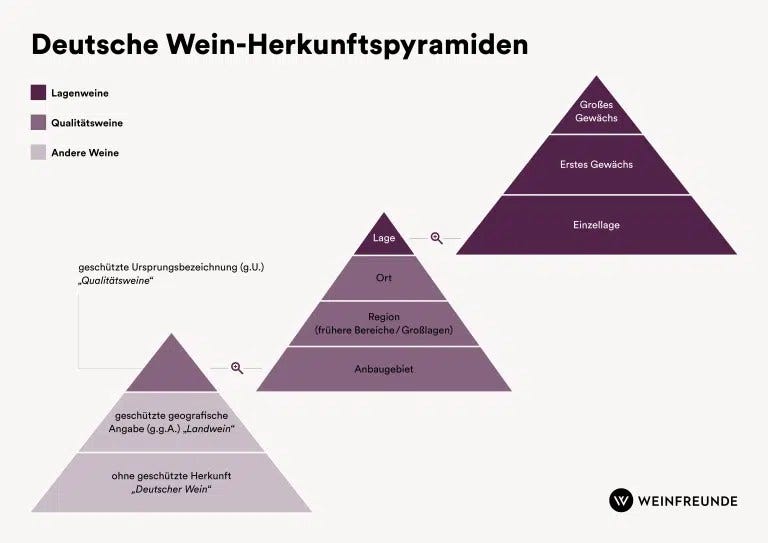
That sounds logical, and it is, provided you are familiar with the new terminology. Below is the quality ladder from high to low, followed by an explanation of the three pyramids upon which the system rests.
The eight levels of the new German wine law
- Grosses Gewächs , GG: the very best vineyards, comparable to Grand Cru from Burgundy.
- Erstes Gewächs , EG: a good single-vineyard location, comparable to Premier Cru.
- Lageweine , Lage: wines from one or more specific vineyards.
- Ortswein e, Ort: the name of a village or municipality on the bottle, comparable to French Villages wines.
- Regionsw eine, Region: a larger sub-area, such as Kaiserstuhl in Baden.
- Gebietsweine , gU: wines from one of the 13 Anbaugebiete, such as the Mosel.
- Landweine , ggA: comparable to Vin de Pays in France, or IGP in Italy and Spain.
- Deutscher Wein : wine without a designation of origin; formerly table wine.
The bottom pyramid follows European wine legislation and has three levels. At the base stands Deutscher Wein, without a designation of origin. Above that is Landwein with a ggA (Geschützte Geographical Angabe), comparable to the Dutch Protected Geographical Indication – PGI. The top of this pyramid is the gU (Geschützte Ursprungsbezeichnung), the Protected Designation of Origin – PDO; these are the Quality Wines from one of the thirteen Anbaugebiete.
The middle pyramid further elaborates on the gU category for the German situation. Germany has 13 Anbaugebiete; the largest are Rheinhessen (26,500 ha), Pfalz, and Baden, while the smallest is the Hessische Bergstraße (467 ha). Within such an area exist Regionen, former Grosslagen typically covering more than 600 hectares. Within these lie the Ortsweine from a single village or municipality. At the top are the Lageweine: small geographical units, sometimes consisting of a single vineyard—an Einzellage—with a specific terroir.
The top pyramid divides the Lageweine into three quality levels: the Einzellage itself, the Erstes Gewächs, and the Grosses Gewächs. The strictest criteria apply to the highest categories: permitted grape varieties, maximum yield per hectare, minimum quality at harvest, mandatory manual picking, and a later release date. Well-known Grosses Gewächs vineyards include Pechstein (15.3 ha) near Deidesheim-Forst in the Pfalz and Scharzhofberg (28 ha) near Wiltingen on the Mosel.
The Grosslage disappears, a real gain
A concrete gain for the consumer is the abolition of the misleading Grosslage system. In practice, a wine like Piesporter Michelsberg could originate from up to twenty villages, while the name gave the impression of one specific place near Piesport. From now on, such a wine will be called Bereich Michelsberg, and the suggestion of geographical precision that did not actually exist disappears.
That is a step that matters. At the same time, one might wonder how significant the practical impact is: the average buyer of Piesporter Michelsberg presumably bought that wine based on price, not on terroir awareness. Moreover, names like Piesporter Michelsberg or Niersteiner Gutes Domtal do not legally disappear overnight; producers choose to drop them commercially, but are not yet obliged to do so.
Grosses Gewächs and Erstes Gewächs: legal, but not yet complete
The most discussed part of the new law is the legal anchoring of the top classifications. For the first time, the new Weinverordnung legally establishes the terms Grosses Gewächs and Erstes Gewächs for the entire country, exclusively under strict criteria.
For a Grosses Gewächs, requirements apply that are diametrically opposed to commercial convenience. Mandatory are:
- manual harvesting
- a maximum yield of 50 hectolitres per hectare
- a natural alcohol potential of at least 11 percent
- dry ageing with a maximum of 9 grams of residual sugar
- release for white wines only on September 1 of the year following the harvest
However, a fundamental gap lurks here. The DWV framework, which determines which vineyards may bear the status of Grosses or Erstes Gewächs, must first be incorporated into the Weinverordnung. This is followed by approval by the Bundesministerium and the Bundesrat. Subsequently, regional committees determine the actual vineyard classification for each wine-growing area. Those involved expect it to take years before the first legal authorizations are granted.
The title is enshrined in law; legally, the list of vineyards permitted to bear it barely exists yet.
VDP and the law: brothers, but not twins
The VDP, the Verband Deutscher Prädikats- und Qualitätsweingüter , the association of approximately 200 top producers founded in 1910, had already been working with its pyramid of Gutswein, Ortswein, Erste Lage, and Grosse Lage for more than twenty years. The new law is clearly inspired by that system, but the two are not copies. While the VDP classification remains a private mark of quality, the law opens the door for a broader use of the top classifications.
From now on, non-VDP members may also use the terms Erstes Gewächs and Grosses Gewächs, provided their wine meets the statutory minimum requirements; this also applies to large producers and cooperatives.
It is precisely that point that is causing tension. VDP President Steffen Christmann warned that Germany is ‘taking an enormous risk by declaring a Premier Cru and a Grand Cru’, especially if commercial pressure leads to vineyards of lesser quality obtaining the prestigious classifications anyway. The classification now exists by law; the guardian of the gate is not yet there.
Prädikatsweine: style, no longer a judgment of quality
Those accustomed to viewing Spätlese as a quality level must revise their frame of reference. The Prädikaten, from Kabinett to Trockenbeerenauslese, are not disappearing from the dictionary, but are acquiring a different meaning. From now on, they function as an indication of wine style based on must concentration, not as an independent quality system. Theoretically, a Spätlese is now possible at every level of the origin pyramid, from Anbaugebiet to Einzellage.
At the same time, more and more producers are opting for direct style designations on the label: Trocken (dry, maximum 9 grams of residual sugar), Halbtrocken or Feinherb (9 to 18 grams), Lieblich (18 to 45 grams), and Süß (more than 45 grams). This makes the choice of style more accessible to the consumer, although these terms also remain relatively arbitrary regarding the actual perception of sweetness.
What does the consumer concretely gain from this?
This is where it gets interesting, and frankly, uncomfortable. The law was designed primarily from the perspective of the producer and the legislator. The consumer benefits indirectly, but the road to get there is long.
What the buyer of the 2026 vintage will notice: misleading Grosslage names are gradually disappearing from the label. Landmarks such as ‘Ort’ and ‘Lage’ are being used more consistently. From now on, a bottle with Grosses Gewächs on the label meets statutory minimum requirements for production and origin.
What the buyer still does not know: whether a Grosses Gewächs from a non-VDP producer truly delivers Grand Cru quality.
The law guarantees the procedure.
The taste remains an open question.
And what happens to the small winegrower who cultivates a few rows of vines in a top vineyard but is not a VDP member? Is he allowed to use the label, and if so, on what grounds?
A good practical example is the Goldtröpfchen vineyard near Piesport on the Moselle. It covers approximately 23 hectares. Of the 25+ plot owners, 10 are VDP members. Will the others soon be allowed to use the GG quality label as well, provided they adhere to the rules?
And then there are the price consequences. Stricter criteria, lower yields, manual harvesting, and mandatory ageing periods are driving up the cost price structurally.
A Grosses Gewächs is by definition more expensive than a Lagenwein from the same vineyard; understandable and economically logical, but the new top of the pyramid remains financially out of reach for many consumers.
What specifically changes for the consumer?
Practical impact:
The consumer receives a more consistent label, but not yet a simpler system. Knowledge of and about the producer and the style remains essential.
Conclusion: the foundation is in place, the top is still under construction
The new Deutsche Weinverordnung is a serious and necessary reform. Abolishing the Grosslage deception is a real improvement, and the origin pyramid is more logical than the system it replaces. And the legal anchoring of Grosses and Erstes Gewächs is a step the sector should have taken long ago.
At the same time, honesty is preferable to euphoria. What this law is not yet, in 2026: a system that gives the consumer direct and complete clarity about which vineyard represents the absolute top. The Lagenklassifikation , the actual Grand Cru list, still exists primarily as a framework on paper.
Anyone who expected in 2023 that 2026 would bring the moment of complete clarity is partly right. The law is in effect. But the deepest layer of the system, the classification of Germany’s best vineyards, is still years in the making. “Origin is everything”, so goes the credo. Fully understanding that origin requires a little more patience.
Last updated: 7 September 2026