
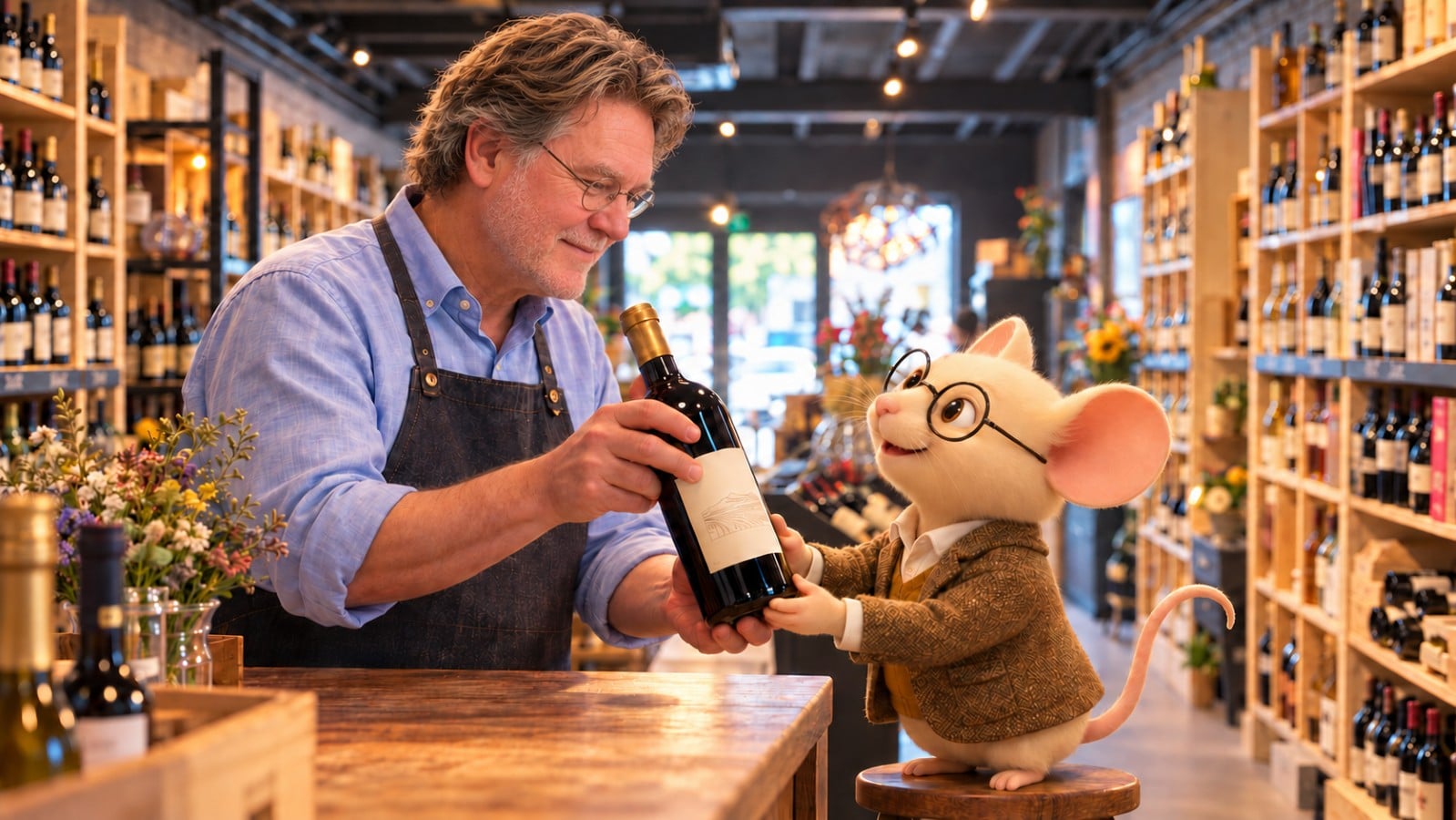
The guest has chosen his food and wants to order wine to go with it. The sommelier comes to the table and asks about his taste and budget. He recommends a sixty-euro bottle the guest would probably never have picked himself. An unknown winemaker, perhaps even an unknown grape variety. Yet, the guest agrees without much hesitation. He trusts the sommelier and leaves part of the choice to him.
That is often how it goes with wine. With an unfamiliar bottle, it is difficult to judge in advance whether you will like it. Label, appellation, producer, grape variety, price, scores, and recommendations all offer clues, but in the end the cork has to come out and you have to taste. That is the moment you find out whether the wine meets your expectations. Whether the recommendation deserves the trust you placed in it.
In 2009, Lacey, Bruwer and Li published a study on uncertainty in wine choices at an Australian restaurant. Guests relied on, among other things, the reputation of the restaurant and the advice of the staff. Previous experiences with the restaurant and with the chosen wine also reduced that uncertainty.
Choosing without tasting
Origin, grape variety and alcohol level help you select a wine. You can compare televisions by screen size, resolution and connectivity. With wine, it remains uncertain beforehand whether you will enjoy it. Even the price offers little certainty.
That is why consumers also look at medals, points, tasting notes and recommendations. In 2019, Thrane published his research into the influence of reviews and recommendations on wine choices among Norwegian consumers. In his experiment, participants chose red wines with very good reviews more often than wines with reasonable reviews. A recommendation from other consumers also made a wine more attractive.
Wine knowledge plays a part as well. In 2005, Dodd, Laverie, Wilcox and Duhan published a study among 632 wine consumers in Texas. They examined how much the participants knew about wine and how much they thought they knew. Participants who scored higher on the wine knowledge test placed greater value on information from wine guides, reviews and advertising. Those who rated their own knowledge more highly placed greater value on those sources and on their own preferences. They attached less value to recommendations from friends, acquaintances and sales staff.
For a wine seller, that is useful. A customer who believes he knows a lot about wine may give more weight to what he has read than to the seller’s recommendation. A customer who is less sure of his knowledge may have a greater need for personal advice. The seller can respond to this by asking what the customer already knows or has read.
Then the bottle is opened
Now you compare your experience with your expectations. Does the wine suit the purpose it was bought for? A bottle for a midweek spaghetti bolognese is a very different matter from a bottle for an evening with your tasting group. With a gift, what counts is what the recipient thinks of it.
At friends’ houses, you may want a bottle that makes a good impression. In a restaurant, you look for a wine that works for you and the others with the various dishes. And sometimes you simply want an affordable wine with a bag of crisps on the sofa. Or a wine you enjoy and can pick up at the late-night off-licence round the corner.
In 2010, Jaeger, Danaher and Brodie published a study on wine choices during a meal with friends in a restaurant. Among other things, the researchers asked how important previous good experiences, staff advice and the match with the food were. Of the participants, 76 per cent said they would place the emphasis differently on another occasion. Participants who were heavily involved with wine attached more value to grape variety, origin and a good food and wine pairing.
So the sixty-euro bottle can be technically excellent and still not fit. A full, ripe red can be too heavy for a light dish. Two tables away, the same wine may go perfectly with a stew.
The conditions in which the wine is drunk matter too. A red wine served too warm may be less enjoyable than the same wine served at a lower temperature. Cooking smells can make it hard to smell the wine properly. That applies in a restaurant with an open kitchen, but also at home.
Judging the advice too
After drinking, you have a verdict on the wine and on the advice you were given.
Research by Jung-Kuei Hsieh and Yi-Jin Li on online product reviews appeared in 2020. Research on credibility usually concerns the information consumers receive before a purchase. After buying, they can compare that information with their experience. Three experiments showed that consumers adjusted their trust in the review website after experiencing the product. A positive review followed by a disappointing product could damage that trust.
Now move that mechanism back to the restaurant. The sommelier recommends an unfamiliar Etna Rosso with the main course. The guest enjoys the wine and it suits the food. Three months later, the same guest is back in the restaurant. The Etna is no longer on the list, and the sommelier suggests a Cabernet Franc from Saumur. The guest agrees. The previous recommendation pleased him, so he trusts the sommelier’s advice this time too.
Which experience gets repeated?
The last wine was a success. Yet this time you choose a different bottle. You try another cuvée from the same producer. Or you ask the merchant who advised you so well for a new recommendation.
You enjoyed an Assyrtiko. Now you want to try more Greek wines. You go back to the same merchant and say: ‘Pick another Greek wine I haven’t tried.’ Or you choose a wine from the same appellation, made by a different producer. Your earlier experience helps you decide what to buy, even when you pick a different wine.
A visit to a winery can also be a reason to buy from that producer again. You tasted several wines there and were looked after well.
In 2013, Bruwer, Coode, Saliba and Herbst published a study among 108 visitors to cellar doors in the Barossa Valley, Australia. A pleasant visit was associated with a greater willingness to buy wine from the winery again.
In 2021, Prayag, Disegna and Bruwer published a study among 676 cellar door visitors in that same Barossa Valley. They looked separately at satisfaction, bottles purchased and the intention to return. Satisfied visitors bought more bottles and were more likely to want to return. The number of bottles bought, however, did not predict that intention. And whether visitors actually came back was not investigated.
Borrowed trust
With an unfamiliar wine, you mainly go by what others say or write about it. You have not tasted it yourself, but you already trust their judgement. That trust is borrowed for now. From Michelin, James Suckling or Jancis Robinson. You go by Vivino users, by the sommelier who says the wine suits the dish, or by your local wine merchant. The reputation of Bordeaux or a Burgundy classification can give you confidence too.
How much weight you give to advice depends on your view of the person giving it. In 2023, Bailey and colleagues published a meta-analysis of 346 effects from 129 datasets with a total of 17,296 participants. It covered tasks in which participants could adjust their own estimate after receiving advice.
Participants were told, for example, that the advice came from an expert or from a novice. They gave more weight to the expert’s advice. In the combined analysis, information about the adviser’s quality was the only factor examined that remained associated with the weight of the advice once the other factors were also considered.
If the merchant picks five wines in a row that you enjoy, you remember that. With his sixth recommendation, you also rely on your own experience of him. That trust can be damaged quickly, though. In 2000, Yaniv and Kleinberger showed through experiments that advisers lost a good reputation more easily than they built one. Brace yourself, a cliché is coming. As the Dutch say: trust arrives on foot and leaves on horseback.
When the wine disappoints, but the advice holds up
Things also get interesting when a wine disappoints. One merchant is enthusiastic about nearly every bottle: ‘Fantastic wine, right up your street.’ The other asks what the customer likes to drink and also tells him what might make the wine less suitable; the firm tannins, for instance.
Of course, a bottle from that second merchant can disappoint too. The customer may find the wine unpleasant and still be satisfied with the advice. He knew roughly what to expect. On his next visit, he can say what he did not like. That helps the merchant guide his choices further.
In 2007, Tenney, MacCoun, Spellman and Hastie studied the credibility of witnesses. When part of a witness statement turned out to be wrong, it mattered how certain the witness had been. A witness who had stated something firmly lost more credibility than a witness who had said beforehand that they were not sure. Two experiments showed this.
With wine advice, you can ask a similar question: did the merchant leave room for doubt, or did he promise the bottle would definitely please?
Well made, still disappointing
A wine can be well made and still disappoint. On advice, you buy a fifty-euro Barolo. The merchant tells you enthusiastically how the wine will develop over the coming years. You were looking for a bottle for that evening. With dinner, you mostly find it austere.
With a two-hundred-euro Burgundy, you may expect something special. The wine tastes good, but you cannot see why it costs so much more than the thirty-euro bottle you drank last week. You expected more.
That is when it matters what the merchant said beforehand. Did he say the Barolo still needed years? Or did he ask what you expected from a two-hundred-euro bottle? You can be disappointed in the wine and still keep your trust in the merchant.
Choosing again after tasting
To be sold, a bottle first has to be seen. The label has to stand out. A score or medal has to convince. The appellation has to mean something to the buyer. The retailer needs a reason to take that particular bottle off the shelf and recommend it. Producer, importer and specialist retailer all try to give the first purchase a nudge.
With the next purchase, the buyer’s own experience comes into play. The consumer has tasted the wine or given it as a gift, and may have seen how others reacted. He knows what he paid and whether he thought it was worth the money. He can buy the same wine again. Or another wine from the same producer, the same region or the same shop.
Sales figures do not simply tell you why a customer buys wine again. If purchases are linked to individual customers, till data can show which wine each customer buys next. But his reason is not recorded: ‘That last one you picked for me was good. Give me something like that again.’
For the wine merchant, that is valuable. The customer comes back and buys another bottle. The earlier advice evidently pleased him and gives enough confidence to try an unfamiliar wine once more.
And there it is: the second bottle.
Sources
Bailey, P. E., Leon, T., Ebner, N. C., Moustafa, A. A., & Weidemann, G. (2023). A meta-analysis of the weight of advice in decision-making. Current Psychology, 42, 24516–24541. https://doi.org/10.1007/s12144-022-03573-2
Bruwer, J., Coode, M., Saliba, A., & Herbst, F. (2013). Wine tourism experience effects of the tasting room on consumer brand loyalty. Tourism Analysis, 18(4), 399–414. https://doi.org/10.3727/108354213X13736372325957
Dodd, T. H., Laverie, D. A., Wilcox, J. F., & Duhan, D. F. (2005). Differential effects of experience, subjective knowledge, and objective knowledge on sources of information used in consumer wine purchasing. Journal of Hospitality & Tourism Research, 29(1), 3–19. https://doi.org/10.1177/1096348004267518
Hsieh, J.-K., & Li, Y.-J. (2020). Will you ever trust the review website again? The importance of source credibility. International Journal of Electronic Commerce, 24(2), 255–275. https://doi.org/10.1080/10864415.2020.1715528
Jaeger, S. R., Danaher, P. J., & Brodie, R. J. (2010). Consumption decisions made in restaurants: The case of wine selection. Food Quality and Preference, 21(4), 439–442. https://doi.org/10.1016/j.foodqual.2009.08.017
Lacey, S., Bruwer, J., & Li, E. (2009). The role of perceived risk in wine purchase decisions in restaurants. International Journal of Wine Business Research, 21(2), 99–117. https://doi.org/10.1108/17511060910967962
Prayag, G., Disegna, M., & Bruwer, J. (2021). Do satisfied cellar door visitors want to revisit? Linking past knowledge and consumption behaviors to satisfaction and intention to return. Tourism Analysis, 26(2–3), 211–224. https://doi.org/10.3727/108354221X16079839951475
Tenney, E. R., MacCoun, R. J., Spellman, B. A., & Hastie, R. (2007). Calibration trumps confidence as a basis for witness credibility. Psychological Science, 18(1), 46–50. https://doi.org/10.1111/j.1467-9280.2007.01847.x
Thrane, C. (2019). Expert reviews, peer recommendations and buying red wine: Experimental evidence. Journal of Wine Research, 30(2), 166–177. https://doi.org/10.1080/09571264.2019.1614548
Yaniv, I., & Kleinberger, E. (2000). Advice taking in decision making: Egocentric discounting and reputation formation. Organizational Behavior and Human Decision Processes, 83(2), 260–281. https://doi.org/10.1006/obhd.2000.2909
This article first appeared in Dutch on Winecastr.com. The English version was translated with AI support and checked before publication.
Last updated: 12 October 2026