

Since 7 July, Michelin has been rating wine producers with one, two or three grapes. Burgundy went first; Bordeaux followed today. That gives the consumer a foothold in an opaque market. Domaine Arnoux-Lachaux received one grape. The estate says it was never visited by Michelin, and publicly asked to be removed from the list.
A conspiracy without conspirators
The wine world has turned wine into a puzzle.
We smell violets, blackcurrant, tea and wet gravel. We talk about acidity, tannin, oak, reduction, terroir, vintages, classifications, scores, and scarcity. To understand wine, you first have to learn the language of the wine world. Even experts constantly lean on the knowledge and judgement of other experts.
It is a conspiracy without conspirators. Nobody designed the system this way, yet producers, merchants, critics, sommeliers, educators and writers all keep it going together. Probably me too.
Meanwhile, the consumer mostly wants a wine that does something in their life. One that tastes good, suits the food, makes an impression, works as a nice gift, signals status or simply fills an evening. Once the bottle has found a function, the second purchase follows almost by itself.
From the bottle to the Grape
The wine world has traditionally judged the bottle: the vintage, the grape variety, the wine in your glass. Michelin takes an entirely different approach. The Grape rates the producer who made the wine. Tasting obviously remains essential, but the vineyard and the cellar now count seriously too. The bottle becomes part of a broader assessment of the estate.
One, two or three grapes do not say: this wine is good. They do say: this producer is trustworthy.
In doing so, Michelin is trying to restore something the wine world has lost: the connection with the consumer. The buyer no longer has to understand every tasting note, vintage, classification, and winemaking decision. Michelin has gathered that complicated knowledge and translated it into one recognisable symbol: the Grape.
Modern wine criticism draws its authority mainly from the individual wine: smell, taste, judge. Michelin shifts the primary object of assessment to the producer. An inspector walks through the vineyard, stands in the cellar, tastes back through ten vintages. The Grape itself is public. What exactly that inspector weighs while doing so remains a black box.
What the Grape does and does not say
On 7 July 2026, Michelin introduced the Grape in Dijon. The Burgundy selection lists 94 estates across four tiers: nine with three grapes, 20 with two, 33 with one, and 32 in the ‘Selected’ category, without a Grape. I wrote about the announcement of this system back in December, and about the introduction of the Grape itself in July. This is the third instalment.
Five criteria
The Grape rates the producer, not the bottle. Michelin works out that distinction through five criteria. Quality of agronomy measures soil health, vine balance and vineyard management. Technical mastery assesses precision in the cellar. Identity weighs the personality, place, and culture of the winemaker. Balance tests the harmony between acidity, tannin, oak, alcohol, and sweetness. Consistency tests steady quality across several vintages, including difficult years.
In an interview with Vino Joy on 30 July 2026, Chinese wine critic Alexandre Ma called that model worn out (see also my earlier article on this). The old wine-criticism model was, in his view, simple: ‘I taste, I tell you what I think, and you listen.’ Ma sets a tougher standard: a critic only counts once a consumer can say the bottle fitted exactly what they were looking for. Michelin does not ask whether the bottle fits. It asks whether the producer is trustworthy.
Those five criteria are not all unclear in the same way. Agronomy, technical mastery and consistency are anything but transparent: the concept is clear enough, but Michelin does not publish the measurement method, the standard, or the threshold. Identity stays conceptually vague. Personality, place, and culture are barely testable, which makes the criterion itself difficult to falsify.
Balance falls into a third category, and it is the most striking one. This measures the wine in the glass, directly and sensorially. The producer behind it plays no role here. Michelin promises a verdict on the maker, yet delivers, on one of its five criteria, a classic wine judgement.
No ranking, but recognition
Yet, that changes the core question of the whole system: which producer can you trust, if a fifth of the answer is about the bottle rather than the maker?
Traditional wine critics judge the wine and sometimes use the producer as context. Michelin reverses that: it judges the producer and uses the wine as a supporting factor.
Michelin, incidentally, already owns the classic wine judgement. Robert Parker Wine Advocate rates individual wines, vintage by vintage, on the hundred-point scale. With the Grape, Michelin adds a second layer on top of that. The question is no longer how good a wine is right now. The question is how much trust the estate deserves over a longer period.
Back in July, I attributed a pecking order to the Grape. I put Armand Rousseau with one grape below Hubert Lamy with three. That was too crudely put. Michelin does present the categories as ascending tiers, but resists the interpretation as a league table. Three grapes place a producer at a higher recognised level than one grape; within a given level, no order is applied.
The questions I asked at the time therefore still stand: which observations move a producer to one, two or three grapes, and what does the trust that Michelin organises with them actually rest on?
What a distinction promises a consumer
Compare the principle to a gold medal at a wine competition. At competitions where I sit on the tasting panel, including the Concours International du Gamay in Lyon and the Concours des Grands Vins du Monde in Mâcon, such a medal is above all a trust signal: an aid for the consumer choosing from an overwhelming range.
What trust rests on
Victor Gomez of Armonia, organiser of, among others, the Concours des Grands Vins du Beaujolais and the Concours International du Gamay, draws a distinction between the reputation of the judge and the verifiability of the method. ‘The reputation of whoever awards a distinction can create trust, but transparency about the method is what makes that trust hold up.’
At his competitions, Gomez says, the value of a medal therefore rests not only on the organiser’s reputation or the quality and independence of the tasting panel, but also on ‘a rigorous, blind, regulated and verifiable process’. That allows the consumer to check what the distinction on the bottle is actually based on.
The Concours des Grands Vins du Beaujolais, for instance, carries a threefold accreditation: recognised by the French Ministry of Agriculture, ISO 9001 certified, and registered on the official DGCCRF list of competitions permitted to award medals for use on a label. The number of medals awarded may not exceed a third of the wines entered, a legal limit the DGCCRF has enforced since 2013.
Such a medal does not say whether the consumer will enjoy the wine, whether it offers good value for money, or whether it suits their dish. They may reasonably assume, though, that a professional panel found the wine technically sound and of a quality convincing enough to merit the distinction.
A gold medal, moreover, does not rank. At a competition, dozens, or hundreds of wines can win gold; they have all met the required standard.
Gold, in other words, is a threshold, not a rank
The Michelin Grape does something similar for the consumer. The symbol does not say which bottle tastes good, which cuvée to buy, or which wine offers the best value. One, two or three grapes say: according to Michelin, this is an estate you can trust.
Michelin puts it this way itself: every level has its value and merit. ‘Selected’ and one grape are standalone recognitions, awarded to reliable, high-quality producers. Each level, according to the press office, tells a different story, ‘not a hierarchy of merit’.
But that formulation, of course, sits awkwardly. The four categories visibly do form a hierarchy: three grapes sit above two, two above one, one above ‘Selected’. So Michelin presumably means something else: every level is a positive recognition, and within a category, producers are not ranked against one another.
Precisely for that reason, the image of a league table leads to the wrong question. That Dugat-Py received three grapes and Rousseau one raises the question of which level Michelin assigns to each estate. It says nothing about an order within that level. The nine three-grape estates stand side by side, not ranked from one to nine.
How Michelin organises trust
Trust sells the choice
In the shop, the consumer usually has no idea how a distinction was actually arrived at. They buy on the outcome: gold, a hundred points, or three grapes. The symbol takes the knowledge work off their hands and gives them trust instead.
A few days ago, I stood in a large Carrefour in front of a wall of rosé. The choice was enormous. Among all those bottles, my eye caught the familiar logo of Reflets de France, Carrefour’s own-brand for regional French products.
That logo does something simple to me. Over the years, I have bought wine, jam, nougat and other products under that brand, and my experience has generally been good. So I do not have to research the entire range again for the next purchase. Reflets de France reduces my uncertainty. It does not say this is the best rosé on the shelf. It gives me enough confidence to reach for this one.
That is exactly what such signals do. They take over part of the consumer’s knowledge work. A gold medal does something similar. And that is also what Michelin is trying to achieve with the Grape.
But what is that trust based on?
At a wine competition recognised and regulated by the French state, the assessment method behind the medal is verifiable. The rules, the composition of the jury, and the oversight are all set down. Even the proportion of entered wines that can receive a medal is capped.
The consumer does not see that structure on the bottle, but it exists all the same. The medal is the visible outcome of a regulated system. The conversion from assessment to trust is verifiable.
Michelin chooses a different route. Instead, the brand itself carries the trust. The consumer is asked to assume that Michelin has carried out the research properly. They do not need to know how many inspectors, visits, vintages, and bottles preceded a given verdict.
For the consumer, that will usually not be a problem. For the producer being judged, it is a different matter.
The black box becomes visible
Asked directly, Michelin confirms that producers pay nothing, neither for the assessment nor for inclusion in the guide. And there are no conditions for participation.
This is where the protest from Arnoux-Lachaux resurfaces. In a signed statement, Florence and Charles Lachaux write that they have never received Michelin, and have not shown their wines to the press since the 2020 vintage: ‘Since 2020, we have deliberately chosen not to submit our wines for press reviews or ratings.’
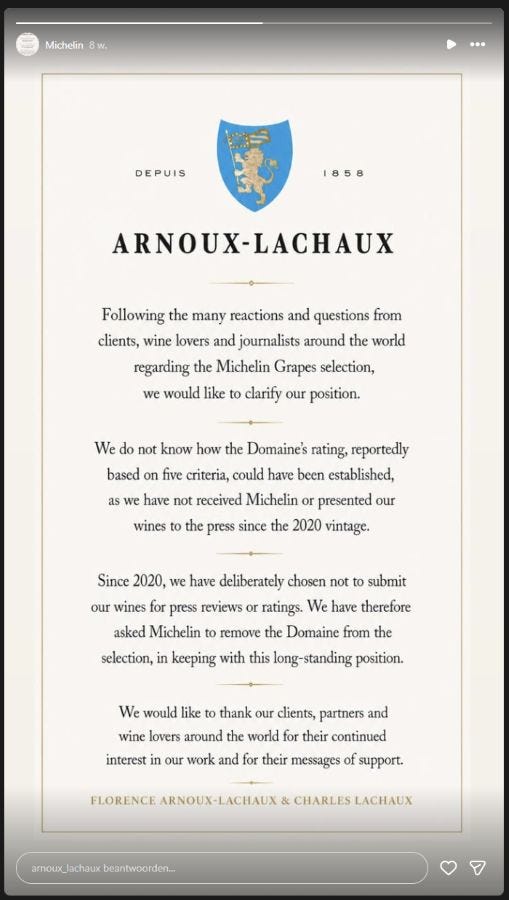
That clashes with Michelin’s own wording that tasting and a vineyard visit are both essential: ‘tasting is as essentially a component as visiting the vineyard.’
Michelin may have bought the wines on the open market or tasted them elsewhere. But if a vineyard visit is essential, and Arnoux-Lachaux says it never received Michelin, a concrete problem arises: the public methodology gives no way to reconstruct how Michelin arrived at one Grape in this case.
That is the black box. Michelin does name its criteria. What stays invisible is which observations, visits and tastings ultimately led to the verdict.
So what does Michelin actually measure?
Asked how the assessment precisely works, Michelin is candid about its own opacity. As with restaurants and hotels, the guide does not disclose the operational details: ‘the number of visits, vintages, or bottles tasted per estate.’
Nor does Michelin publish how the five criteria are weighted against each other. So we know which subjects are assessed, but not how observations, visits and tastings combine to produce ‘Selected’, one, two or three grapes.
Master of Wine Jamie Goode asked the question this practically demands: if an estate does not show its wines to the press, what does the verdict actually rest on? He calls the five criteria vague to the point of uselessness. Michelin’s answer confirms the heart of his point: the guide shows the ingredients, not the process.
Robert Parker Wine Advocate comes back into play here. Michelin stresses that the two approaches differ. Parker rates individual wines by vintage; the Grape rates a producer over a longer period. A Parker score, according to the press office, counts ‘never mechanically’ towards the grape verdict.
The work is not fully separate, though. Robert Parker Wine Advocate reviewers, according to Michelin, are among those who carry out tastings and visits alongside the guide’s own wine inspection teams. The final decision rests collectively with the guide’s salaried inspectors.
The hands around the glass, then, are partly the same. Michelin already owned the judgement on the bottle, and has now built a judgement on the producer alongside it with the Grape.
From Green Star to Mindful Voices
The Grape’s opacity does not stand alone.
On 1 June, Michelin retired the Green Star, the visible sustainability distinction for restaurants. In its place came Mindful Voices. Director Gwendal Poullennec pointedly described it as ‘not an award or a symbol’, but as a platform for practices and stories.
That is a significant turn. The Green Star was a recognisable distinction awarded to a restaurant. Mindful Voices carries no comparable status. No restaurateur hangs a plaque above the door reading ‘Mindful Voice’. Michelin selects voices, chooses stories, and decides who gets presented as an example.
Demian Parasmo’s experience
For Demian Parasmo of Konijnenvoer in Arnhem, meanwhile, the Green Star was anything but symbolic. After it was awarded, interest rose sharply; at one point, the restaurant was fully booked months in advance. He calls Michelin’s decision to end it ‘a bit messy’. At the same time, he does see some logic in Mindful Voices: sustainability, he thinks, may be better explained by having chefs talk about their working methods than by simply attaching a distinction to it.
His experience with the Green Star, however, also exposes a weak spot in the old system. Konijnenvoer filled in a sustainability questionnaire for Michelin. Even so, Demian did not have the impression that this gave Michelin a full picture of what the restaurant actually did on that front. ‘When they gave us the star for sustainability, I did think: nice, glad to have it, but you have no idea what we actually do on sustainability.’
So the shift to Mindful Voices is not simply a transparent rating system being replaced by a black box. Behind the Green Star, too, it remained unclear how deeply Michelin actually checked. What disappears is mainly the visible mark; what replaces it is editorial selection. Here too, Michelin changes the form of recognition without making the underlying scrutiny any more transparent, the same pattern we already saw with the Grape.
And then the Grape appears
A little over a month later, Michelin introduced a new, powerful symbol for wine producers. The Grape is meant to signal which producer is trustworthy. Only Michelin does not disclose how the verdict is actually built up.
That produces a striking movement in opposite directions. For restaurants, the sustainability symbol disappears, and a storytelling platform takes its place. For wine, a new symbol appears in which the way of producing is explicitly weighed in, without the standard behind it being made public.
One of the five criteria is ‘quality of agronomy’. Michelin cites soil vitality, vine condition and vineyard management here. That unmistakably touches on sustainability. But which form of sustainability Michelin actually means remains unknown.
What counts as sustainable for Michelin?
Sustainability is not a single, agreed standard. Intensive production with a very low ecological footprint per bottle can be called sustainable. So can extensive farming that leaves plenty of room for biodiversity. Organic certification measures something different from CO₂ emissions, land stewardship, water use, social conditions, or the lifespan of a vineyard.
For this selection, I checked which of the 94 producers demonstrably carry an organic, biodynamic or other external environmental certification. Some turned out to be traceable certified; others say they work sustainably without any certificate. Strikingly, it is the smaller names who display their certification most clearly, while several top estates remain deliberately uncertified. One caveat: a sizeable share of the 94 have no website, and so cannot be checked online.
That does not mean the remaining estates work unsustainably. It does mean that no single agronomic standard can be inferred from the selection itself.
For the wine producer, that invisible standard is very real, though. Agronomy counts towards the verdict on their reliability. A producer who receives one grape, falls outside the selection, or is chasing a higher rating simply does not know which form of vineyard management Michelin actually rewards.
Michelin does not need to impose formal rules to influence behaviour. The reputational effect of the Grape can be enough on its own to make producers adjust their practices to a standard they can only guess at.
The problem of the négociant
For négociant houses, that ambiguity grows even larger.
Joseph Drouhin, one grape, farms around a hundred hectares of its own vineyard, from Chablis down to the Mâconnais. Alongside that, the house makes wines from bought-in grapes and must, within a range of roughly 150 wines.
Michelin says it applies the same criteria regardless of size or production context: ‘What we judge is the quality in the glass, not the scale of production.’
But agronomy is not only in the glass. Which of the house’s own plots, suppliers and bought-in grapes carry the verdict on the whole enterprise? Does Michelin assess the organically certified estate vineyards, the arrangements with dozens of suppliers, or a representative cross-section of the range?
At a négociant house, Michelin is judging more than one plot of land and one way of working. There is an entire supply chain in between. How that chain is weighed remains unknown.
The other side
For the consumer, the Grape could turn out to be fantastic.
Michelin has already proven that it can order complicated markets in a usable way. On its website, it is easy to search for starred restaurants, Bib Gourmands, hotels, and restaurants within a given price bracket. The guide is not limited to a symbol; it offers descriptions, practical information and a way in to businesses the consumer would struggle to find on their own.
The same could happen with the Grape. Michelin started in Burgundy and is now expanding the system to Bordeaux. Other major wine regions could follow. The consumer gets an overview of producers, their style, their business, visiting options and, eventually, perhaps price levels too.
Michelin itself states this consumer benefit sharply. The selection, according to the press office, is intended for both the seasoned enthusiast and the traveller discovering Saint-Aubin for the first time. The guide’s strength lies in ‘making a technical world accessible without ever oversimplifying it’.
That is exactly what the wine world needs. The Grape shifts attention away from aroma descriptions, points, vintages and classifications, towards a simpler question: which producer am I likely in good hands with?
What does the consumer want, besides a wine that tastes good?
The average consumer will lose little sleep over the number of visits, the vintages tasted, or how agronomy is weighed against technical mastery. They want to know where they can eat well, sleep well, taste well and buy well.
The consumer gets convenience. The wine sector gets a new power holder.
Once consumers start using the symbol, producers, importers, wine merchants, sommeliers, and critics all have to position themselves in relation to it. They are affected by a verdict whose workings are not public. Reputations can shift, tourist flows can change, importers will put the Grape to commercial use, and producers may adapt how they run their business to Michelin’s presumed preferences.
With stars, Bib Gourmands, hotel keys, travel advice, Parker points and now grapes, Michelin is organising ever more links in the chain around the travelling, eating, wine-buying consumer. Whether power is the aim cannot be established. A concentration of authority is the result regardless.
The consumer gets a foothold. The sector gets a new referee.
In closing
The Grape could bring the wine world closer to the consumer. Michelin is doing something the wine world itself has not sufficiently delivered: it translates a complex verdict on viticulture, winemaking, and consistency into an understandable signal of trust.
In doing so, it breaks part of the conspiracy without conspirators. The consumer no longer has to first master the language, rituals, and reputations of the wine world. One, two or three grapes tell them which producer Michelin considers trustworthy. Because the consumer is not buying a wine analysis. They are buying a wine that acquires a function in their life.
They will understand that system quickly, and use it gladly.
The question about the method, then, is not primarily a warning to the consumer. It is a question for the sector being judged. Michelin organises the trust of millions of wine buyers, while the producers do not know how their own verdict comes about, and do not appear able to opt out of it.
Thirteen questions, one silence
I put thirteen questions to Michelin. At first, the press office answered at length. On the method, it was candid: the guide does not disclose how many visits, vintages, or bottles underpin a verdict. On whether a producer can opt out of being assessed or listed, no direct answer came, only a reference to the guide’s ‘editorial freedom’.
I then put targeted follow-up questions, including the direct question of whether a representative of Michelin or Robert Parker Wine Advocate had physically visited Domaine Arnoux-Lachaux. In response, Michelin said it had shared all the information it intended to share on the subject: ‘all the information we intended to share regarding the grapes’ topic’. The question about the visit went unanswered.
So the core of the matter remains unresolved. Michelin calls the vineyard visit essential, while the estate says it never took place. What that single grape actually rests on stays hidden.
The consumer gets a guide.
The wine world gets a new order.
Sources
MICHELIN Guide, official methodology announcement (2 December 2025); MICHELIN Guide, Press Release, MICHELIN Grape (7 July 2026); written answers from the MICHELIN Guide press office to Winecastr (July 2026); speech by Gwendal Poullennec, ‘MICHELIN Guide Restaurant Ceremony Nordic Countries 2026’ (official MICHELIN Guide YouTube channel); signed statement by Florence and Charles Lachaux, Domaine Arnoux-Lachaux (Instagram, July 2026); En-Primeur Club; Vino Joy News; Jamie Goode on Substack; People in Wine Magazine on LinkedIn; Maison Joseph Drouhin, ‘Our Wines’; own research into the certification of the 94 selected producers; own judging experience, see ‘The Real Value of a Medal on Your Wine Bottle’ on Winecastr.com (in Dutch).
This article was first published on Substack on 7 September 2026 and has since been edited and updated for The Wine Shift. The version on The Wine Shift is the maintained version.
Last updated: 14 September 2026