
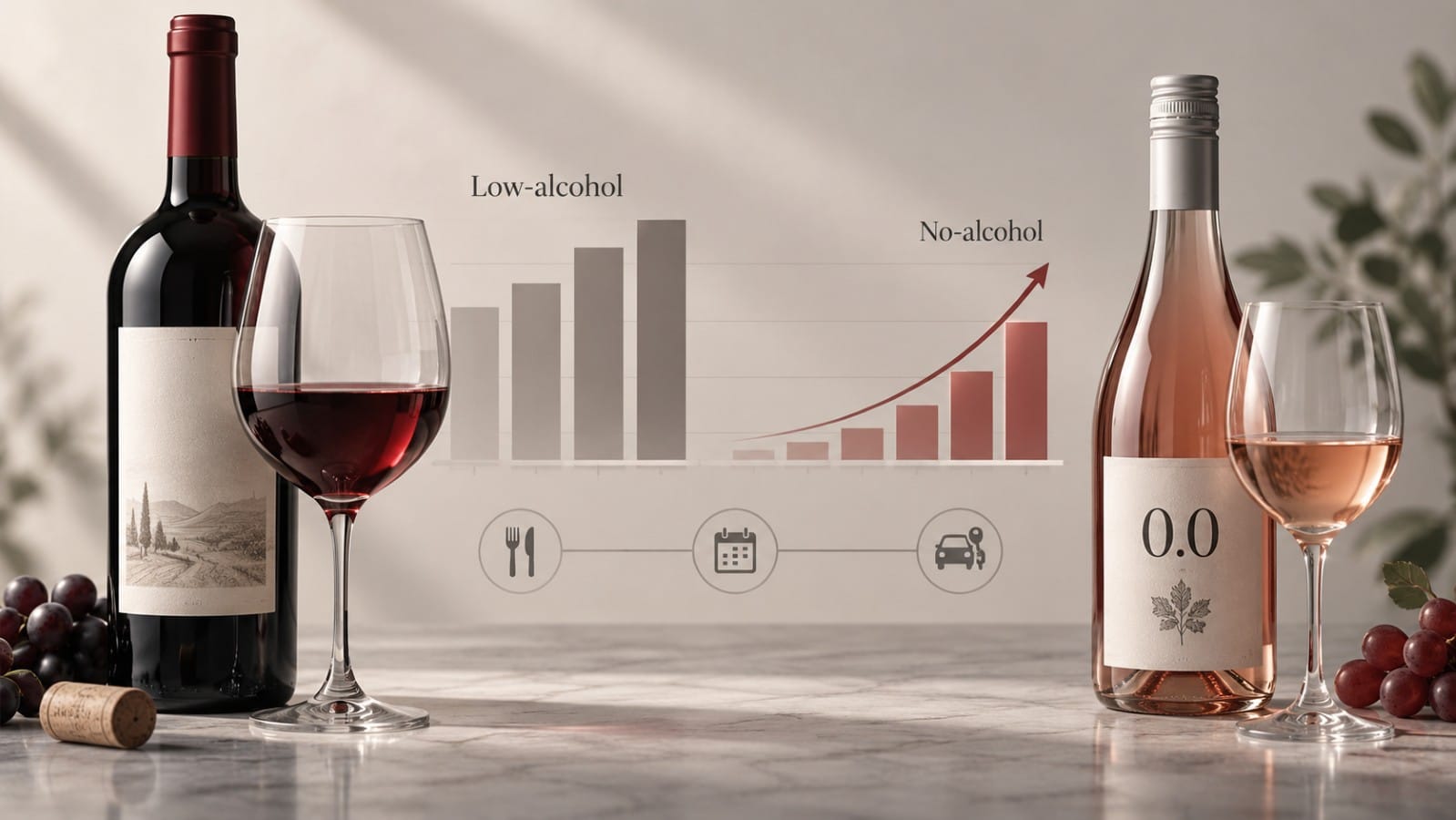
Low-alcohol wine still leads in volume. No-alcohol has the momentum.
That distinction matters.
For years, much of the wine industry has treated moderation as a product problem. Lower the alcohol percentage. Make wine lighter. Develop products at 9%, 8% or 6% alcohol.
Recent IWSR data suggest that consumer behaviour is more complicated.
In its Opportunities in No- and Low-Alcohol Wine 2025 report, IWSR tracked eight major wine markets: the US, Canada, UK, France, Germany, Spain, Japan and Australia. Low-alcohol wine still leads no-alcohol wine in volume. No-alcohol, however, has stronger momentum.
Between 2019 and 2024, no-alcohol wine grew in all eight markets.
Canada recorded a compound annual growth rate of 27%, followed by Japan at 26%, the US at 23%, Australia at 18% and the UK at 15%. Even mature European markets continued to grow: Germany by 9%, Spain by 6% and France by 4%.
The interesting part is what consumers are doing with these drinks.
Moderation increasingly depends on the occasion
IWSR describes consumers combining no-, low- and full-strength products depending on the drinking occasion.
That makes moderation a behavioural choice rather than simply a lower alcohol percentage.
A consumer might drink regular wine over dinner on Saturday, choose alcohol-free wine during the week and switch between both at a social event. The reduction in alcohol takes place across occasions rather than necessarily inside every bottle.
This complicates the assumption that reducing ABV is the obvious answer to declining alcohol consumption.
Low-alcohol wine still has scale. No-alcohol has momentum.
Those are two different things.
The first purchase is becoming less important
Another IWSR finding may be more significant for producers.
Growth in no/low wine is increasingly coming from existing buyers drinking these products more frequently. Growth from new entrants is slowing.
That is what happens when an experimental category begins to become habitual.
A consumer buying alcohol-free wine once can be explained by curiosity, Dry January, driving home or simple novelty. Repeated purchases require something else.
The drink has to earn its place.
That changes the commercial problem considerably.
The sector no longer needs only to convince consumers that alcohol-free wine exists. It has to make them want another bottle.
Taste becomes the real test
IWSR identifies taste perceptions as one of the continuing barriers to purchase.
At the same time, consumer expectations are rising. Buyers increasingly expect no- and low-alcohol wines to provide recognisable wine flavour, work with food and retain a sense of occasion.
That puts pressure on producers.
Removing alcohol is technically difficult because alcohol contributes to body, aroma perception, texture and balance. A wine that solves the alcohol problem while creating a sensory problem has merely moved the weakness elsewhere.
The category could get away with that while novelty was enough to generate trial.
That phase appears to be ending.
Removing alcohol may win the first purchase. Taste has to win the second.
Wine is still chasing beer
Wine also starts from a weak position.
According to IWSR, beer continues to dominate the no-alcohol category. Wine remains much smaller and competes not only with beer, but also with spirits, RTDs and other drinks.
That matters because beer established the alcohol-free drinking occasion much earlier.
Consumers already understand what alcohol-free beer is for. It can replace a beer at lunch, after sport, while driving or during a weekday evening without requiring much explanation.
Alcohol-free wine has yet to achieve the same clarity.
Its opportunity therefore depends on more than improved dealcoholisation technology. Producers need to understand which drinking occasions they are trying to occupy and what consumers expect at those moments.
The second bottle decides
No- and low-alcohol wine buyers are also relatively young. Across the eight markets, 60% are Millennials or Gen Z. In the US that share reaches 73%, and in the UK 67%.
Those numbers will attract attention.
The repeat-purchase data deserve more.
A category driven increasingly by frequency rather than recruitment has entered a different stage of development. Curiosity becomes less useful. Product quality, relevance and drinking occasion become more important.
That is good news for alcohol-free wine because it suggests consumers are beginning to integrate it into normal drinking behaviour.
It also raises the standard.
Alcohol-free wine no longer needs to prove that consumers will try it.
Increasingly, it has to prove that they will come back.
Source note: This article is based on IWSR’s Opportunities in No- and Low-Alcohol Wine 2025 and its public analysis ‘No- and low-alcohol wine surfs moderation trend’. The figures cited refer to the eight markets tracked by IWSR: the US, Canada, UK, France, Germany, Spain, Japan and Australia.