
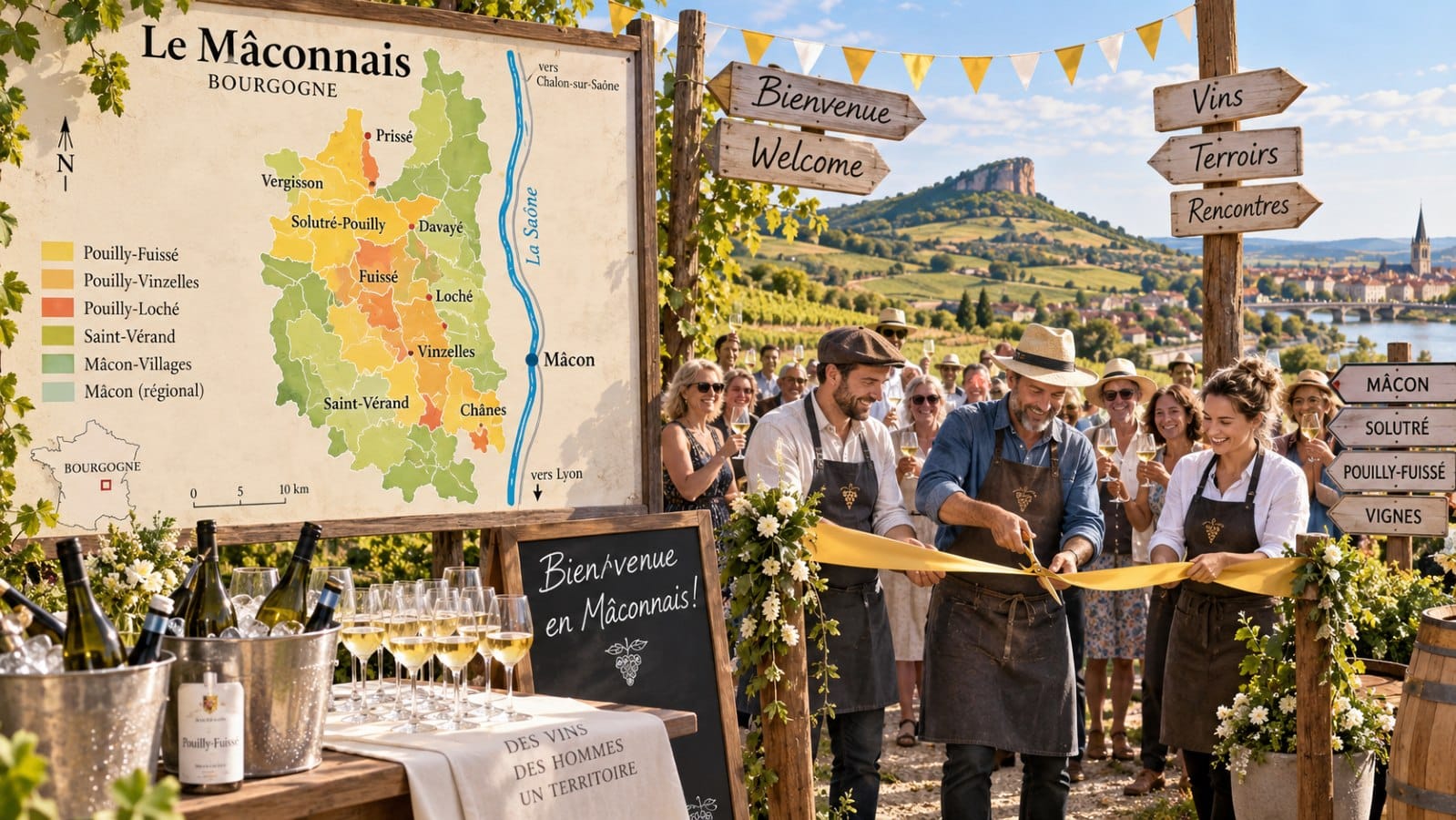
Since August 2026, white Mâcon wines have been allowed to contain additional grape varieties alongside Chardonnay. Minimum planting density has been reduced, while basic Mâcon blanc has gained more freedom in the use of oak fragments. Climate change is an official reason for some of these adjustments. At the same time, they create scope for simpler and cheaper production and for more control over freshness, texture, aroma and oak influence.
Chardonnay gets some help
The new specification for the Mâcon AOC makes Aligoté, Pinot Blanc and Pinot Gris additional grape varieties, the so-called cépages accessoires. Melon and Sacy are also permitted under specific conditions. The old rules were simpler: white Mâcon consisted of 100 per cent Chardonnay.
According to Caroline Guyotat, director of the Union des Producteurs de Vins de Mâcon (UPVM), discussions about this change began in 2021 and 2022. The first application followed later. The UPVM cites 2024 as the year of the first application; the INAO dates the formal submission to July 2025.
Guyotat says Aligoté, Pinot Blanc and Pinot Gris were chosen for their natural acidity and their ability to retain freshness. Christèle Mercier, the INAO’s regional representative for Centre-Est, confirms that climate adaptation is the primary aim of this change. Burgundy also already has experience with these varieties in other AOPs.
Sacy and Melon are being tested as older Burgundian grape varieties. Guyotat points to factors including acid retention, lower potential alcohol, limited susceptibility to certain fungal diseases and the ability to recover after frost.
At least 90 per cent of a producer’s white Mâcon vineyard area must be planted with Chardonnay. Additional varieties may account for no more than 10 per cent of the relevant vineyard area. In an individual wine, however, those varieties may make up as much as 15 per cent of the blend.
At equal yields, a producer could therefore blend around two thirds of production with 15 per cent additional varieties while still keeping roughly one third as 100 per cent Chardonnay.
Fewer vines per hectare
According to Guyotat, reducing the minimum planting density from 7,000 to 5,000 vines per hectare has been under discussion since 2010. The UPVM links the change to climate adaptation, reduced herbicide use, wider grassed rows, easier mechanisation, lower equipment costs and the economic sustainability of wine businesses.
The Mâconnais is not alone in taking this approach. In 2025, the CAVB, the umbrella organisation for Burgundy’s wine-growing ODGs, worked with local INAO services to develop eight standard measures for Burgundy AOP specifications. These cover areas including grape varieties, measures to protect vines and reduced herbicide use. This forms part of a broader acceleration in the adjustment of appellation rules across Burgundy.
The INAO also cites climate adaptation and mechanisation. The new minimum density also brings Mâcon into line with the planting density already permitted for regional Burgundy AOPs.
More freedom in the cellar
The previous specification prohibited the use of morceaux de bois: oak fragments that can release oak-derived compounds into wine during vinification or ageing.
That ban has now been lifted for basic Mâcon blanc. It remains in place for Mâcon-Villages and white Mâcon wines with a geographical designation, such as Mâcon-Lugny.
According to Guyotat, both qualitative and economic considerations played a role in the change: saving time and energy, making cellar work easier and reducing space requirements. The INAO likewise describes the justification as ‘technical and economic’ and points out that the practice is already permitted within the regional Coteaux Bourguignons AOP.
Christèle Mercier of the INAO describes basic Mâcon as the foundation of the local quality pyramid. Mâcon-Villages and Mâcon with a geographical designation sit above it. Their ageing requirements remain stricter, and the use of oak fragments continues to be prohibited.
An appellation under economic pressure
At the beginning of 2026, Jérôme Chevalier, president of the UPVM, described the situation for regional Mâcon wine as ‘dans le dur’, roughly ‘in a very difficult position’.
According to Chevalier, market prices fell by 20 per cent in 2024 and by another 20 per cent in 2025. Producers selling exclusively to négociants were receiving around €600 to €650 per pièce, while production costs were approximately €900.
Chevalier made an important distinction. Bottled sales were holding up, he said, both in export markets and at the cellar door. The greatest pressure is on producers selling regional Mâcon to the négoce.
A pièce is the traditional 228-litre Burgundy barrel. €600 works out at about €2.63 per litre, or roughly €1.97 worth of wine per 75 cl bottle. For a bottle sold in the Netherlands, bottling, bottle, closure, label, transport, excise duty, trade margins and 21 per cent VAT still have to be added.
For years, the UPVM also tried to secure permission to use the wording ‘vin de Bourgogne’ on more Mâcon wines. Chevalier openly argued that this would allow Mâcon to benefit commercially from Burgundy’s image. The Conseil d’État, France’s highest administrative court, brought that attempt to an end in late 2025.
The vineyard changes slowly
A cellar rule can have an almost immediate effect. New plantings take several years before they produce an economically meaningful crop. Some consequences of this change to the specification will therefore only become clearly visible around 2029 or 2030.
The new rules give producers more room to respond to climate pressure, disease pressure, mechanisation and costs, and to steer the flavour profile of their wines more deliberately. The underlying shift among consumers is slow, although specific preferences and buying occasions can change within a few years.
For individual producers, very little may change. Germain Bernard of Château des Correaux in Leynes says his working methods will remain the same. He has no plans to change planting density or grape variety and sees no reason for his estate to make a different style of wine because of the new rules.
Beaujolais is taking a different route
Beaujolais has also lost a great deal of ground. Global exports of red and rosé Beaujolais fell by 81 per cent between 2000 and 2025, compared with 17 per cent for total French wine exports. Yet, there have been relatively few changes in the vineyard and cellar.
One change is the rise of white Beaujolais. Its growth also has a clear competitive logic. Much of the Chardonnay grown in the region is sold as Bourgogne blanc or Crémant de Bourgogne. Inter Beaujolais, the trade body representing growers and merchants in Beaujolais, wants a larger share of that wine to be marketed under the Beaujolais name.
At the same time, a younger generation of growers is looking for a different position for Beaujolais, including red wines with lower alcohol levels that are more often served cool. The quality hierarchy is also being refined, through Fleurie’s Premier Cru project and the proposal for Beaujolais Pierres Dorées as an additional geographical designation.
Growers, caves, restaurants, and entrepreneurs are also seeking direct contact with drinkers and buyers through tastings, gastronomy, wine tourism, direct sales and events. Climate change plays a role here too, although much of the current energy is focused on rebuilding trust with buyers.
Mâcon has a chance to rebuild trust
The revised rules address real problems: climate pressure, disease pressure, mechanisation, costs, and the continuity of wine businesses. The fact that the appellation is actually changing its rules after years of discussion are progress.
The rules are changing, yet it remains unclear why consumers would choose Mâcon more often. The UPVM talks about societal expectations, although the changes themselves do not yet show what position Mâcon wants to occupy with the slowly changing consumer. Greater freedom in the vineyard and cellar may help. It becomes relevant to the market once growers use that freedom to make wines that consumers find relevant.
Buying wine depends to a significant extent on trust. That trust grows first of all because the wine tastes good, and also because the wine has a function. The movement now taking place in the Mâconnais gives producers an opportunity to rebuild that trust.
The second bottle remains a consumer decision. The fact that the Mâconnais is now moving at least increases the chances that there will be a second bottle.
Sources
- Ministère de l’Agriculture / Légifrance, Arrêté du 7 août 2026 homologuant le cahier des charges de l’appellation d’origine protégée ‘Mâcon’, published in the Journal officiel on 13 August 2026. Légifrance: approval of the Mâcon AOP specification
- Institut national de l’origine et de la qualité (INAO), Rapport d’activité 2025: 90 ans – L’innovation en héritage, particularly p. 16 on the standard measures for Burgundy AOPs. INAO: Rapport d’activité 2025
- Abellan, Alexandre, ‘Pas de “vin de Bourgogne” pour l’AOC Mâcon : “franchement, ça gênait qui ?”’, Vitisphere, 10 January 2026. Vitisphere
- Conseil d’État, Décision n° 495017, Union des producteurs de vins de Mâcon, 30 December 2025. Conseil d’État: decision 495017
- Christèle Mercier, déléguée territoriale Centre-Est, INAO, written response to the author, September 2026.
- Caroline Guyotat, director, Union des Producteurs de Vins de Mâcon (UPVM), written response to the author, September 2026.
- Germain Bernard, Château des Correaux, Leynes, written response to the author, September 2026.
- Inter Beaujolais, ‘De futurs premiers crus en Beaujolais’, including the Fleurie Premier Cru project. Inter Beaujolais
- Inter Beaujolais, ‘Excellence Beaujolais Pierres Dorées: la sélection 2022’, on the project for an additional geographical designation for Beaujolais Pierres Dorées. Inter Beaujolais
This article first appeared in Dutch on Winecastr.com. The English version was produced with AI assistance and edited by the author.
Last updated: 18 September 2026