
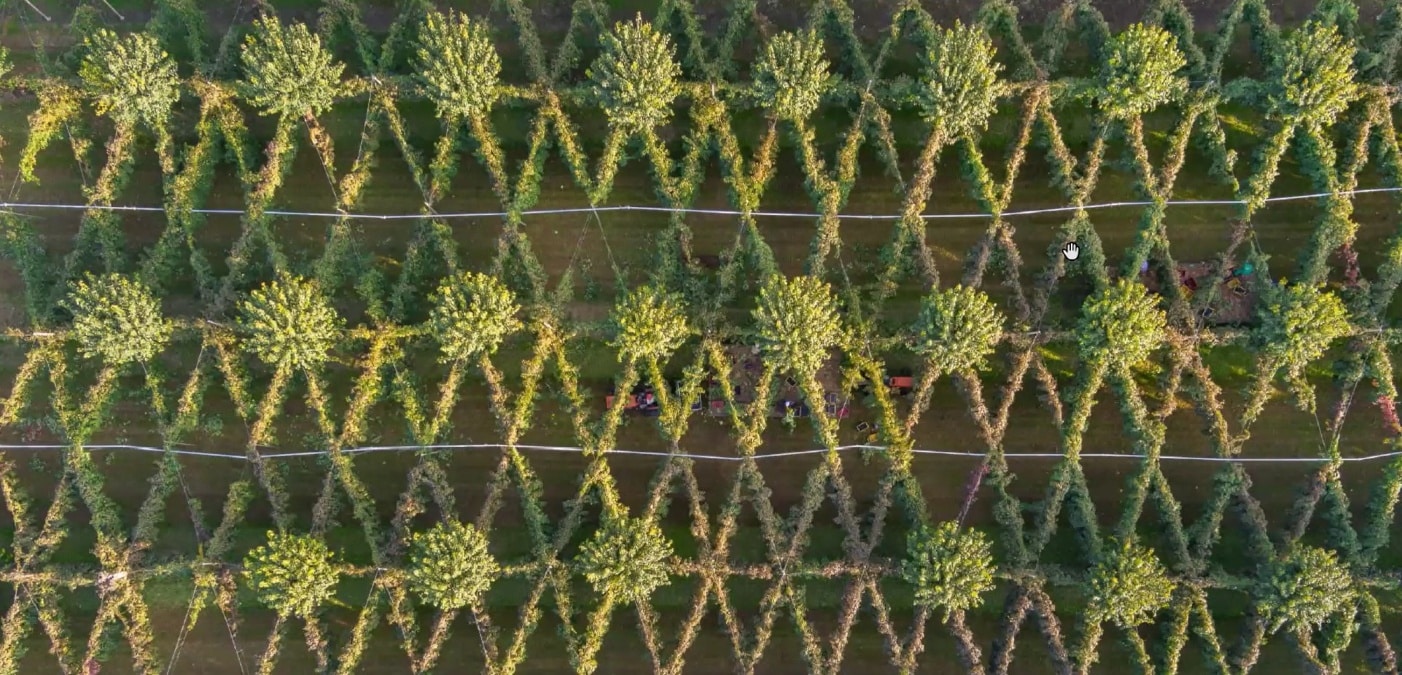
An online tasting, organised by Studio Cru on behalf of the Consorzio Vini Venezia. Four bottles on the table. And a training system I had only ever seen in drawings. That changed the moment Alex Emmanuelli, export manager at Ca’ di Rajo, showed an aerial photograph of a vineyard near San Polo di Piave.
Diagonal lines. A radial pattern. A geometry you would sooner expect above a fortress than above a vineyard on the Veneto plain.
That is Bellussera. And the wine it produces is called Nina.
A vine pattern as geometric art
The Bellussera method emerged at the end of the nineteenth century. The Bellussi brothers developed it in Tezze di Piave, a village not far from the river Piave. In an era of poverty, sharecropping and epidemic vine diseases, the Veneto countryside was searching for solutions. Bellussera was one of them.
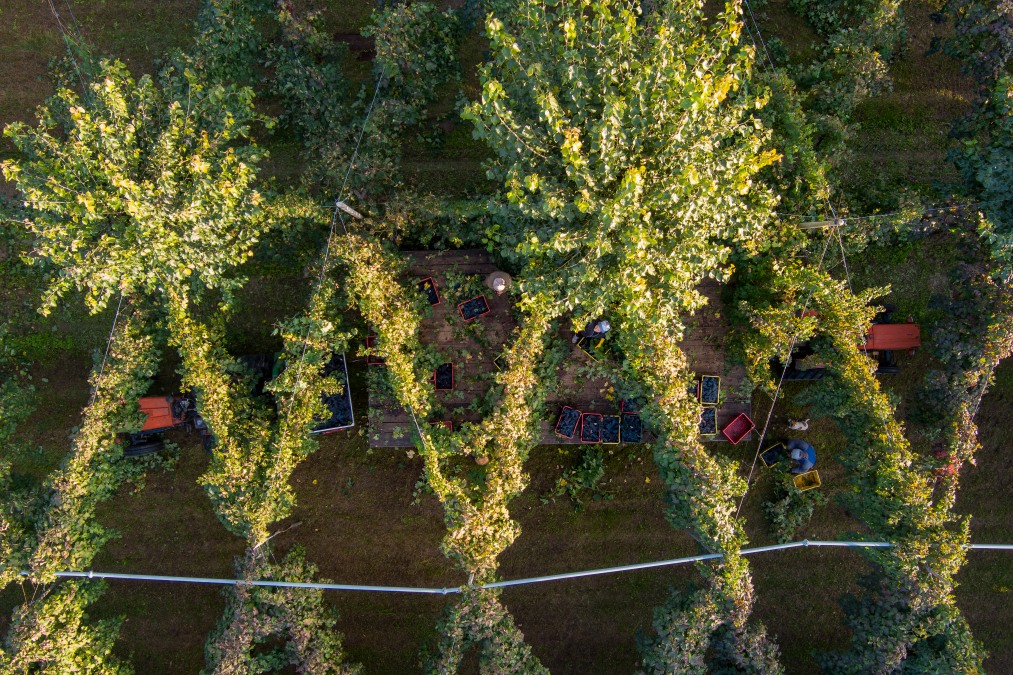
The principle is simple. Wooden posts three to four metres high carry a network of wires. Four vines stand around each post. They climb upwards and then extend diagonally outwards, like the spokes of a wheel. The result is a vineyard that literally hangs in the air.
The bunches grow more than two metres above the ground. Mulberry trees often used to rise above the vineyard. They were indispensable for the silkworm farming that flourished on the Veneto plain for centuries, and they completed Bellussera as a landscape. Whether Ca’ di Rajo still uses mulberry trees as central supports, and how the estate handles possible differences in ripeness between inner and outer bunches, remained unconfirmed for this article.
Bellussera carries no protected designation of origin. It is a historic training system and part of the landscape heritage of the Piave area, which several producers and local initiatives protect and promote (‘tutela e valorizzazione’). Ca’ di Rajo is one of the participating producers, and the logo on the Nina label refers to that.
From above, such a vineyard looks like a honeycomb. Or a spider’s web. It is a pattern you only understand once you stand inside it, under a green ceiling of foliage, with the bunches above your head.
Why this vineyard once made sense, and does again
Bellussera looks like a curiosity. That picture is only half right. The system arose out of sheer necessity, in a region where humidity, disease pressure and poverty set the rhythm.
Along the Piave, vineyards lay low and wet. Downy mildew had free rein. Grapes growing higher up dried faster after rain and caught air from every side. The difference was practical and showed directly in the harvest.
That open structure did more. A pergola forms a closed roof; Bellussera lets wind and light through. Bunches hang freely, ripen more evenly and are slower to develop rot. In effect, the system creates a microclimate that helps the plant.
Yet the most forgotten advantage lies beneath the vines. Bellussera was rarely a monoculture. Grain, vegetables and fodder crops grew between the rows. In a sharecropping system where farmers had to hand over part of their harvest, that made the difference between getting by and staying dependent.
What was a necessity then takes on a different meaning now. The Veneto plain is warming, and temperatures have risen noticeably over recent decades. Grapes hanging higher up benefit from airflow and from distance to the warm ground. The system tempers heat without technology. No fans, no irrigation: structure does the work.
Therein lies the irony. What disappeared because it was inefficient turns out to suit present conditions unexpectedly well. The catch: labour rarely wins against efficiency. And Bellussera demands labour. A great deal of it.
Why the system nearly disappeared
Despite those advantages, Bellussera has become a rarity.
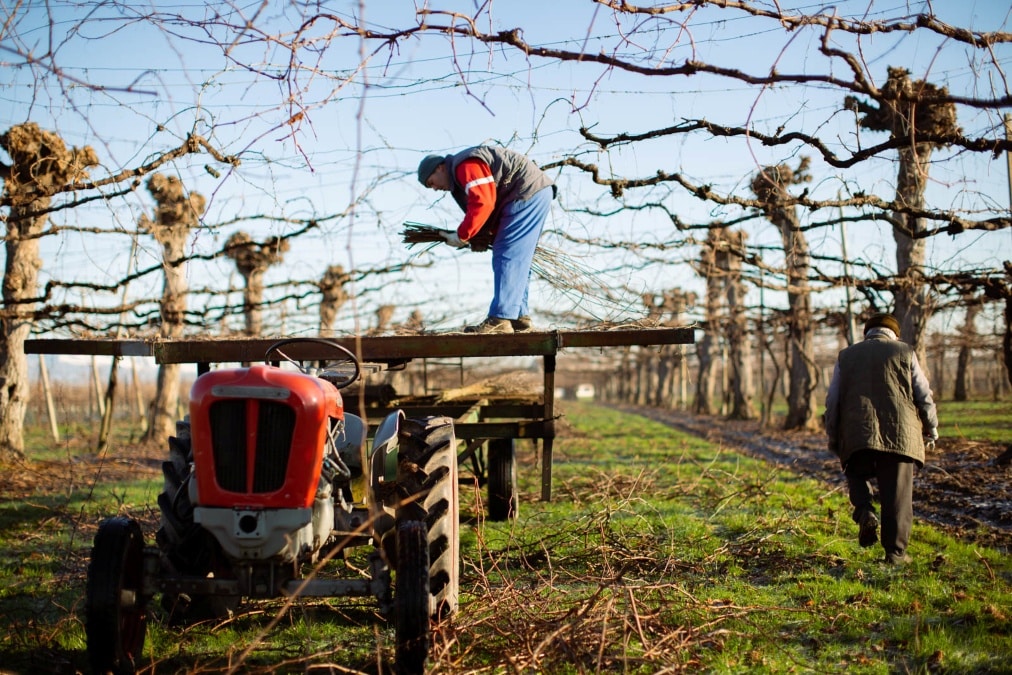
The reason is simple: money. Pickers harvest a Bellussera vineyard above their heads. Pruning requires ladders or special platforms. Mechanisation is virtually impossible. Labour costs run three to five times higher than for a mechanised Guyot system. Put the main systems side by side and you immediately see why Guyot and Sylvoz took over the landscape in the age of the tractor:
| System | Bunch height | Planting density / rows | Mechanisation | In brief |
|---|---|---|---|---|
| Bellussera | high (bunches > 2 m) | relatively wide, low density | very limited, much handwork | radial pattern, vineyard in the air |
| Pergola | high | moderate, dense foliage | limited | horizontal canopy overhead |
| Guyot | low to medium | relatively high, narrow rows | well suited | modern system for quality and efficiency |
| Sylvoz | medium to high | moderate | designed for mechanisation | longer pruning, popular on fertile plains |
From the second half of the twentieth century, most growers switched to lower systems: Guyot, Sylvoz, spur-pruned cordon. Densely planted, efficient to harvest, profitable sooner. Gradually, the Bellussera vineyards vanished from the landscape.
The total Bellussera area in the province of Treviso is probably below 100 hectares, spread over a handful of producers. No central register exists.
Ca’ di Rajo: a living archive
Ca’ di Rajo in San Polo di Piave still owns around twenty hectares of Bellussera vineyards, one of the largest contiguous areas surviving today. Other producers that actively use the system include Ornella Molon and Bonotto delle Tezze, both in the province of Treviso.
For the estate, these plots are more than a historical curiosity. They are the source of Nina, a Manzoni Bianco Piave DOC that shows the full potential of this combination: old Bellussera vines, a unique grape and a soil of clay, sand and rounded river stones.
Ca’ di Rajo also farms Guyot plots. A direct comparison between the two systems on yield, sugar levels or aromatic profile was not available for this article. What sets the Bellussera plots apart is measurable in an indirect sense: older vines, lower yields per plant and a growing environment that allows on-vine appassimento without cold rooms or drying racks.
Visitors to the estate often stand amazed among the rows. Walking through a Bellussera vineyard means walking under a green ceiling, with the grapes hanging above your head. No modern system offers that experience.
Manzoni Bianco: a crossing with character
Incrocio Manzoni Bianco 6.0.13 is a cross between Riesling Renano and Pinot Bianco. Professor Luigi Manzoni developed it in the 1930s at the viticulture school in Conegliano. The grape combines the aromatic finesse of Riesling with the texture and structure of Pinot Bianco.
Ca’ di Rajo lets the grapes dry slightly on the vine, a light appassimento. The open Bellussera structure promotes air circulation around the bunches. For on-vine drying that is a practical advantage: the bunches dry more evenly and run less risk of botrytis than in denser systems. Cold maceration follows for about ten hours. This step extracts aromatic precursors from the skins, the monoterpenes behind the floral richness. Fermentation runs on selected yeasts at a controlled temperature. Part of the wine then ages for at least four months in tonneaux.
In the glass: bright, intense straw yellow. The nose offers pineapple, apricot, exotic fruit, peach blossom and wisteria. On the palate the wine is full and structured, with good acid balance and a long finish of exotic fruit. At 13% alcohol it gains texture without turning heavy.
Serve at 12 °C. Suggested pairings: fish dishes, white meat and semi-mature cheese. Ca’ di Rajo itself recommends asparagus risotto. The pairing works because the wine’s minerality and freshness keep the creamy dish in balance, while the tropical fruit matches the gentle sweetness of asparagus.
Tai: a grape with a past and a new name
Besides Bellussera, Tai was the other discovery of this tasting.
The grape has a long history in north-eastern Italy. Until 2007 it was called Tocai Friulano. The name had to go after a long-running EU dispute with Hungary: Tokaj, the Hungarian wine region, had objected to the similar-sounding name. Veneto chose Tai. Friuli chose Friulano. Two regions, one grape, two names.
That naming history comes at a price. Internationally, Tai lags behind Friulano, simply because the new name has built up less recognition. It is a marketing handicap for a grape that does not deserve one.
In the Lison area, Tai finds a terroir that makes it special. The caranto, a compacted clay layer 30 to 70 centimetres below the surface, acts as a natural water reservoir. Roots barely penetrate it. The plant draws on the moisture that collects just above the layer. The result is a wine with minerality, a characteristic almond note on the finish and a dryness you will not forget.
The other three wines: some context
The tasting comprised four wines. The other three gave Nina its context.
Ai Galli’s Lison Classico DOCG is 100% Tai, grown on clay soil in Pramaggiore using the Sylvoz system. Thanks to the caranto layer, the grape finds an ideal habitat here. The wine undergoes pre-fermentation maceration at a controlled temperature and ages on fine lees in steel. The result: straw yellow with green hints, acacia and exotic fruit on the nose, and that characteristic almond note on the finish.
Furlan’s Manzoni Bianco (Piave DOC) from San Vendemiano takes a different route from Nina. Furlan uses inverted Guyot at 4,800 vines per hectare and leaves the wine on its lees for six months for extra texture and complexity. The profile is more accessible: ripe fruit, tropical notes, straw yellow with golden reflections.
Mazzolada’s L’Eugenia ‘63 is the most complex of the group. It is a Lison Classico DOCG, 100% Tai, from a vineyard planted in 1963 on flat, calcareous soil. The estate uses Sylvoz and hand harvesting, macerates cold for 12 to 14 hours and ages the wine for six months, 80% in steel and 20% in oak. On the nose: chamomile, citrus, grapefruit, basil, a hint of vanilla and bitter almond. The palate is dry, powerful and long. This wine calls for heartier pairings: salt-baked fish, lobster pasta, blue cheese.
A vineyard as an argument
More and more vineyards are designed for mechanisation. Low training, narrow rows, high planting density. Easy to work, predictable yields, lower costs per hectare. Bellussera works differently. Bunches hang more than two metres up. Pruning and harvesting require ladders or platforms. Machines play a limited role.
At Ca’ di Rajo, that produces a clearly different vineyard. The open structure ensures constant air movement. Bunches dry faster after rain and hang further from the heated ground. In a warmer climate, that is first and foremost a practical advantage. It also puts Bellussera in a different light. Many modern systems were developed for yield and scale. Along the way, training systems that combined several functions disappeared: winegrowing, food production and land use in a single plot.
Its official status remains limited. Bellussera appears on a regional heritage list in the Veneto, yet it lacks international recognition. That sits at odds with the agronomic logic of the system.
Nina makes the difference visible in the glass. The wine has ripeness and structure, with enough tension to carry the whole. Its profile traces straight back to the vineyard it grows in. That is the heart of the matter. Bellussera is a well-functioning system with clear advantages, and some old training systems suit today’s climate better than many people assume.
Photo credits: all photographs supplied by Studio Cru, Vicenza.
This article first appeared in Dutch on Winecastr.com. The English version was translated with AI support and checked before publication.
Last updated: 12 October 2026