
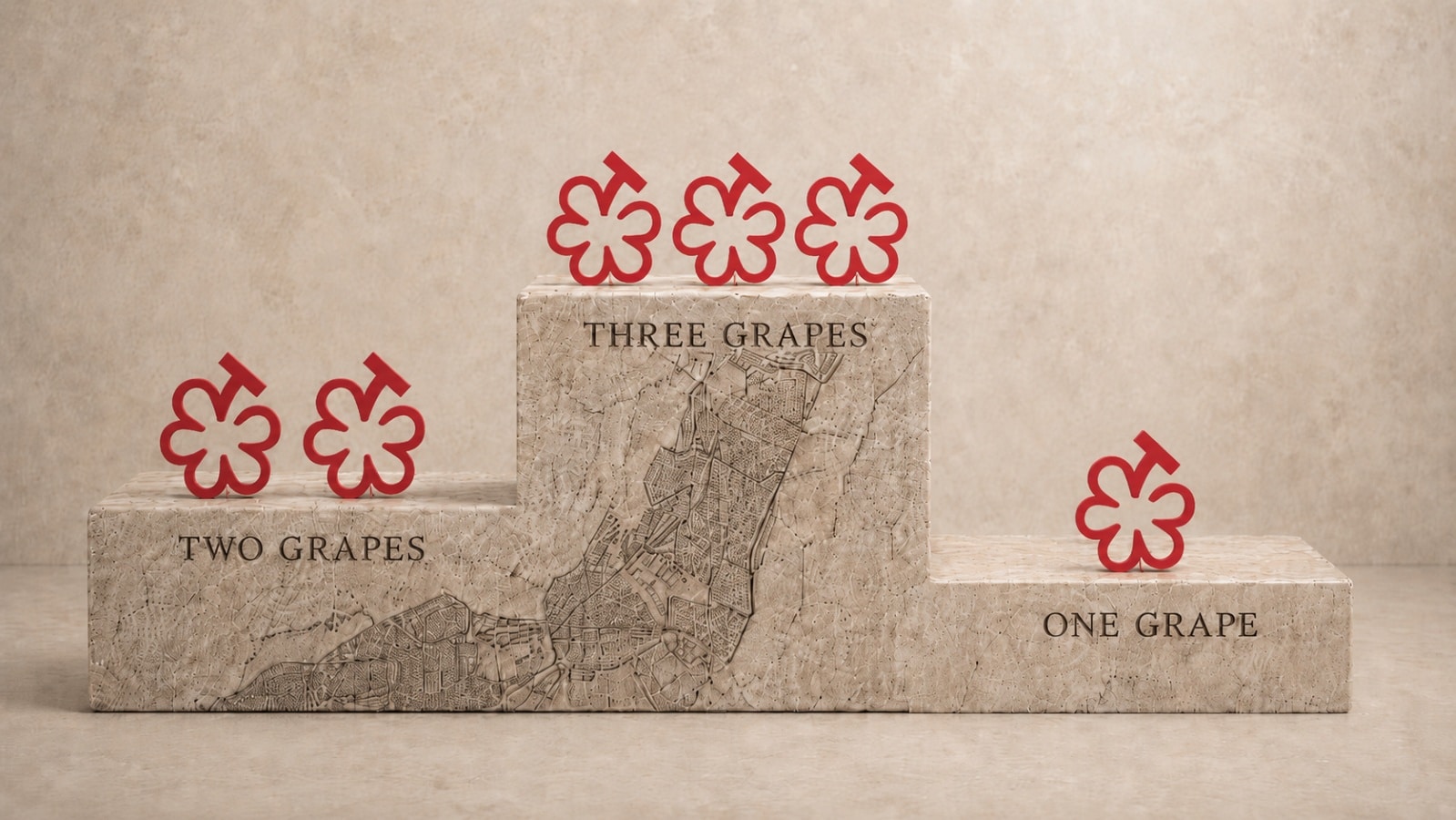
On 7 July 2026, Michelin published its first Grape Selection for Burgundy. Inspectors ranked 94 estates in four categories, from ‘Selected’ up to three grapes. Nine producers reached the top tier, among them Domaine de la Romanée-Conti (DRC). The surprises sit beside them and below them: The MICHELIN Guide’s Burgundy Selection.
Below the top nine come 20 estates with two grapes, 33 with one grape and 32 in the ‘Selected’ category. The result is a pyramid with four tiers.
Burgundy already has a pyramid of its own, and one of the most finely meshed in the world. Regional appellation, village, Premier Cru, Grand Cru, climat, lieu-dit, producer, vintage: the region lives off distinction. Michelin adds a simpler ordering on top. Its inspectors assess the trust that a producer, in their view, earns across multiple vintages.
The appellation organises origin. Michelin tries to organise trust.
Burgundy lives off origin
In Burgundy, Michelin judges the producers, while the region’s existing order of reputation rests mainly on the location of the vineyard.
That difference seems small, yet it touches the heart of the region. Burgundy thinks in terms of origin. A few metres of vineyard further on can mean a different climat. A single plot can yield regional wine, village, Premier Cru or Grand Cru. Ownership is fragmented; dozens of producers each make an entirely different wine from the same climat.
The iconic Clos de Vougeot shows how far origin and ownership can diverge in Burgundy. The walled Grand Cru covers more than 50 hectares and counts around 80 owners. Buy a Clos de Vougeot today, and you buy, above all, a famous name and a place within the walls; quality varies sharply from one owner to the next. Even so, the Clos does hold genuine craftsmanship: Château de la Tour, the largest owner and the only one to vinify within the walls, received a one-grape rating in Michelin’s first selection.
That is precisely where what Michelin adds becomes visible: a judgement on the producer, on top of the reputation of the vineyard.
Vintage, soil, exposure, plant material, harvest timing, extraction, whole clusters and élevage further determine what ends up in the glass. Over the centuries, Burgundy has developed an extraordinarily detailed map of all of this. Bourgogne Maps now translates that historical precision into digital form. Michelin lays a simpler legend over the top: four categories for producers, from ‘Selected’ to three grapes.
Hubert Lamy three grapes, Armand Rousseau one
This first round of selection turns genuinely interesting now that Michelin dares to pass over names the market crowned long ago.
Domaine de la Romanée-Conti, Domaine Leroy, Domaine d’Auvenay, Coche-Dury, Roumier, Cécile Tremblay and Dugat-Py all fall into the highest category: for connoisseurs, that largely confirms what the market, scarcity, and reputation have shown for years.
Hubert Lamy makes the list more intriguing. The estate lies right up against Chassagne-Montrachet and Meursault, in Saint-Aubin. In that appellation, Premier Cru is the highest level. Michelin places Lamy in the same top category as DRC, Leroy and Coche-Dury. The same pattern appears with Jean-Marc & Thomas Bouley from Volnay, also three grapes, also an appellation without a Grand Cru.
Set against that stands Armand Rousseau with a single grape. Rousseau ranks among the most famous names of Gevrey-Chambertin and owns vines in some of Burgundy’s most prestigious Grands Crus. On the wine market, Rousseau counts as an icon. Michelin places the estate in the category of excellent producers, with two more levels above it.
Five criteria do not yet make a method
Michelin publishes five assessment criteria, but how the system actually works remains, for now, difficult to verify.
The inspectors assess agronomic quality, technical command, identity, balance, and consistency across multiple vintages. Those terms give a direction, and at the same time leave all the room in the world. Take identity. In a region where every climat has its own style, that term can mean almost anything Michelin wants to see in it.
That is precisely why the method matters. Agronomic quality is more than a tidy row of vines and a convincing cellar visit. Soil vitality can be observed, measured and interpreted, and each of those three yields a different kind of evidence. An inspector who tastes and observes judges differently from a laboratory that measures.
Balance and consistency seem simpler, yet they too are fraught. A cool vintage shows a different structure from a warm one. A young Burgundy can be austere, closed, or angular and still fall into place years later. Consistency across multiple vintages is, moreover, a different task for a small estate than for a larger house with dozens of cuvées.
Michelin presents its method as rigorous and transparent. Rigorous the method may well be; transparent it is, so far, barely. That is where the uncomfortable core lies. Michelin organises trust through a method that has yet to prove itself.
How the inspectors work, Michelin does not spell out. Do they visit the vineyard or only the cellar, do they taste blind or with the label in view, across how many vintages, after how many visits, and by whom? Winecastr put these questions to Michelin; the answer will follow in a second article.
The grape cluster as compass
For the consumer, the promise of Michelin Grapes is simple: get lost less often in Burgundy. Because Burgundy is intimidating for many buyers. The names are numerous, the prices high, availability erratic, and the gap between a smart purchase and an expensive disappointment can be wide. A recognisable symbol usually helps at that point.
One grape stands for an excellent producer with recognisable wines, most convincing in the better vintages. Two grapes promise exceptional quality and consistency within the region. Three grapes form the heaviest commitment: trust in the estate, regardless of the vintage.
That is where the commercial power lies. The consumer has to fathom fewer details about climat, lieu-dit, barrel ageing, reduction, vintage, and producer history. The symbol takes over much of that work.
For beginning Burgundy buyers, that can be very useful. For advanced drinkers, it remains at most a second compass, or a confirmation of earlier choices. In Burgundy especially, the specific bottle stays decisive: which cuvée, which year, which price, which style? At exactly that level, Robert Parker Wine Advocate passes judgement, and Michelin already owns that instrument.
Robert Parker comes into the same cellar
Robert Parker Wine Advocate (RPWA) made the hundred-point scale, on which a wine scores up to a hundred points, the international standard. According to RPWA, a score is a summary of the quality judgement on a wine at the moment of tasting. The accompanying tasting note is meant to show what the number conceals: style, personality, value and ageing potential.
But the market remembers, above all, the number: 100 Parker points!
That number has helped producers, shaped styles, driven up prices and set entire markets in motion. The power of the number lies with the market that reacts to it; ownership lies, by now, entirely with Michelin. In 2017 the tyre maker acquired a stake of forty per cent; in 2019 RPWA became a full part of the Michelin Group.
So Michelin does not start from zero. The group already owns the best-known assessment machine of the modern wine market; with Grapes, a producer classification is added on top. That gives Michelin two levels of wine authority under one roof: the score judges a bottle from a single vintage, the grape judges the estate as a source of trust.
Those two logics can reinforce each other and collide. A wine can score highly at RPWA while the estate stays outside the Michelin selection. Conversely, an estate with three grapes can make a bottle that underperforms in a given year. Then two truths arise under one roof: the score offers a grip on the bottle, the grape casts doubt on the estate. Or the other way around.
Michelin starts where the spotlights already shine
With Burgundy, Michelin opts for maximum visibility. The region has international reputation, high prices, tourist appeal and names like DRC, Leroy, Coche-Dury, Lamy and Rousseau. A first Grape Selection in Burgundy draws attention without Michelin having to explain the region at all. Commercially logical. And safe, too.
Yet, that choice grates. Burgundy is scarce, expensive and, for ordinary drinkers, ever harder to reach. The top end is moving towards allocation, auction, corporate gift and luxury cellar. In doing so, the region touches the same vulnerability that haunted Bordeaux for years: prestige coming loose from the pleasure of drinking.
Beaujolais would have been the better stress test. In Moulin-à-Vent, Morgon, Fleurie, Saint-Amour or Côte de Brouilly, Michelin could have shown whether its grape also works in a region with a real hunger for recognition. In Burgundy, the guide starts among producers who are often already famous, scarce and expensive.
The grape always costs something
For the three-grape producers, the Michelin classification can have an immediate effect. At DRC, Leroy or Coche-Dury, a grape mainly confirms what the market already knows: these wines are scarce, expensive and, for many buyers, practically out of reach. For names like these, a stamp can even work the other way around. Anyone who has been the absolute benchmark for decades does not need validation from a tyre maker; for DRC, a grape is a gesture rather than a verdict.
For Hubert Lamy and Jean-Marc & Thomas Bouley, the effect can be larger. They receive an international mark of quality that is quickly found outside the circle of Burgundy insiders, too. That can lead to more demand, smaller allocations per customer and higher prices.
For the consumer, that works out cruelly. Michelin promises to point the way to a good producer, and then makes that same producer harder to reach. The discovery and the disappointment come from the same source. Whoever finds their way to Lamy through the grape may, a year later, be standing further back in a longer queue.
Lower-ranked estates feel the new order as well. One grape or ‘Selected’ stays commercially useful; it provides copy for websites, importers, wine lists and tourist routes. Yet, every position takes on meaning the moment Michelin builds the pyramid. A famous estate with a single grape has a lot to explain.
The heaviest reputational damage threatens producers who fall outside the selection entirely. As long as it stays unclear whether they were examined, fell outside the scope or were judged insufficiently convincing, the market fills that gap on its own. In Burgundy, reputation is fragile, and worth a great deal financially.
A new inspector on the farm
For wine producers in Burgundy, Michelin arrives on top of an already crowded table. An estate already had to deal with appellation rules, merchants, critics, importers, sommeliers, allocation customers and auction prices. Now a private guide joins them, with a judgement that reaches beyond the bottle: Michelin also assesses the work in the vineyard.
A wine can be impressive in the glass while the work in the vineyard, in Michelin’s view, falls short. Then the judgement is no longer about aroma, taste, structure and length, but about the way the wine comes into being. Michelin assesses the trust a producer earns, and now draws the vineyard into that as well.
In theory, that can turn out well. Producers who work carefully with soil, plant material and vineyard management gain recognition for work that classic wine criticism often ignores. Only, the grape recognises nothing in particular. Michelin adds five criteria up into a single figure, and in that figure what it stands for disappears. Because Michelin does not publish the relative weighting of the five criteria, three grapes give no indication of how heavily the work in the vineyard counted. The recognition of fieldwork that Michelin seems to offer therefore stays invisible in the final result.
In this way, a private company sets itself up as an authoritative judge of good vineyard management, alongside appellation bodies, certifiers, and the legislator. Their standards have a formal basis; Michelin’s influence arises because the market and the consumer take the judgement seriously.
When does the real litmus test come?
With the grapes, Michelin shows that the guide dares to rank producers in a region where reputation lies extremely exposed.
Trust is the new category in a market already full of classifications, scores, and status. Yet, Burgundy remains a safe shop window. The names are big, the prices high, the attention guaranteed. Michelin hardly needs to explain to the world why Burgundy matters.
The real test comes outside Burgundy. In Bordeaux, Michelin Grapes will soon collide with châteaux, classifications, the logic of en primeur and the almost untouchable legacy of 1855. In Beaujolais, the Loire, the Languedoc or in Germany, it will have to prove whether the system also makes visible producers who currently fall outside the international premium market.
That is where it becomes clear what Grapes really is: an instrument of discovery, or a reputation amplifier for estates already in the shop window.
For now, the doubleness prevails. Michelin gives the consumer a useful symbol in a complicated market. At the same time, the group tightens its grip on wine choice, wine tourism and producer reputation.
The appellation organises origin. Michelin tries to organise trust. That is exactly why this new grape deserves attention: it judges wine, producers and, by now, a way of working too. Attention becomes demand, demand becomes scarcity, scarcity becomes price.
We are about to find out.
MICHELIN Grape Selection Burgundy 2026: the full list
Michelin published its first Grape Selection on 7 July 2026. Below are all 94 estates, ranked from three grapes down to ‘Selected’. Where available, the name links to the estate’s own website.
Three grapes
Cécile Tremblay, Coche-Dury (Wikipedia), d’Auvenay (Wikipedia), Domaine de la Romanée-Conti, Domaine Leroy, Dugat-Py, Hubert Lamy, Jean-Marc & Thomas Bouley, Roumier.
Two grapes
Arnaud Ente, Benoit Ente, Benoît Moreau, Bonneau du Martray, Bruno Clair, Bruno Lorenzon, Denis Mortet, Domaine des Comtes Lafon, Domaine des Croix, Domaine Leflaive, Dujac, Dureuil-Janthial, Etienne Sauzet, Georges Mugneret-Gibourg, Gérard Mugneret, Jacques-Frédéric Mugnier, Jean-Claude Bachelet, Jean-Marc Vincent, Lamy-Caillat, Paul Pillot.
One grape
Armand Rousseau, Arnoux-Lachaux, Benjamin Leroux, Bernard-Bonin, Château de la Tour, Claude Dugat, Clos de Tart, Comte Georges de Vogüé, Denis Bachelet, Domaine de Montille, Domaine des Lambrays, Domaine Ponsot, Domaine Sylvain Cathiard, Duroché, Faiveley, Ghislaine Barthod, Henri & Gilles Buisson, Henri Boillot, Henri Germain, Hudelot-Noëllat, Joseph Drouhin, Joseph Roty, Louis Jadot, Louis Boillot, Marc Colin, Marquis d’Angerville, Méo-Camuzet, Michel Lafarge, Pierre-Yves Colin-Morey, Roblet-Monnot, Roulot, Trapet, Vincent Girardin.
Selected
Alain Gras, Albert Bichot, Alex Moreau, Anne Boisson, Bachelet-Monnot, Ballot-Millot, Benoit Chevallier, Berthaut-Gerbet, Bouchard Père & Fils, Buisson-Charles, Camille & Guillaume Boillot, Camille Thiriet, Charles Audoin, Cottenceau, Felettig, Fourrier, Hubert Lignier, Jacques Carillon, Jobard-Morey, Joseph Colin, Lafouge, Nicolas Perrault, Pierre Boisson, Pierre Girardin, Pierre Guillemot, Pierre Morey, Ramonet, Rapet, Sylvain Pataille, Thomas-Collardot, Vincent Dancer, Yvon Clerget.
This article first appeared in Dutch on Winecastr.com. The English version was translated with AI support and checked before publication.
Last updated: 12 October 2026