
An online tasting, organised once again by Studio Cru. Six wines from Famiglia Casadei, across three estates: Castello del Trebbio in Chianti Rufina, Tenuta Casadei on the Tuscan coast near Suvereto, Tenuta Olianas in inland Sardinia.
One family, three entirely different terroirs, one philosophy they call BioIntegrale. Ten principles, from ‘feed the soil, not the vine’ to the idea that wine should above all express grape, soil, and vintage. Nicely put. Also a bit more of the same, in a wine world already full of sustainability manifestos.
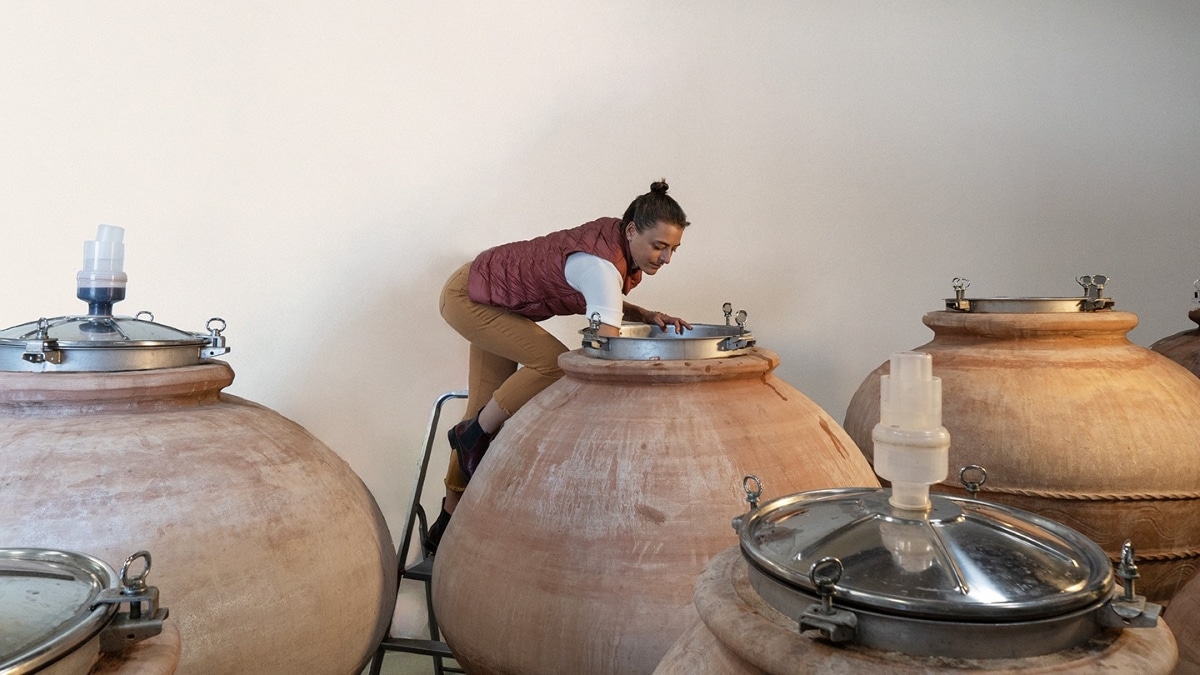
What kept pulling at my attention during the tasting was something else: not the manifesto, but the clay vessels used to make these wines.
Between steel and wood
One wine in the line-up reflects a striking choice: the De’ Pazzi Toscana IGT 2020 from Castello del Trebbio. The blend runs 60% Sangiovese, with 20% Merlot and 20% Syrah. The four-hectare vineyard sits at roughly 450 metres, on clay-rich soil heavy with galestro, near a castle dating to 1184.
The Sangiovese harvest is split before fermentation. Around twenty percent goes into terracotta amphorae; the rest ferments in stainless steel. Worked through the blend, that means roughly twelve percent of the final wine undergoes alcoholic fermentation in terracotta. Merlot and Syrah ferment in steel as well.
Malolactic fermentation happens in the same vessels. The Sangiovese then ages eighteen months in second-use tonneaux. Merlot and Syrah go into new and second-use barriques. That sounds like a technical detail. It is, in fact, a meaningful winemaking decision with real consequences for the vinification.
A steel tank wall is close to airtight and releases almost nothing into the wine. That gives the winemaker fairly precise control over temperature and oxygen contact, and lets the grape’s fruit take centre stage. Wood, by contrast, lets in small amounts of oxygen over time while also contributing tannins and aromatic compounds such as vanilla, toast, smoke, coconut, and spice. Wood, in other words, plays an active role.
Terracotta behaves differently again, distinct from both wood and stainless steel. Uncoated clay can let oxygen through while contributing far fewer recognisable aromas than oak. How much oxygen actually passes through the wall is expressed as OTR, the Oxygen Transmission Rate, and that value varies by vessel depending on clay composition, firing temperature, porosity, wall thickness, and any coating. That oxygen, in turn, drives reactions between tannins, anthocyanins, and other wine components.
Limited oxygen exposure can encourage reactions between tannins and anthocyanins in red wine, which can produce more stable colour compounds. The outcome is never guaranteed in advance, though: wine composition, temperature, pH, contact time, and the specific properties of the vessel all shape the result together. That’s somewhat comparable to how winemakers think about oak in terms of origin, barrel size, age, and toast level.
Terracotta typically adds far fewer aromas than new oak, which can let the primary fruit stay more recognisable. The material isn’t fully aromatically inert, though: oxygen exposure and the course of fermentation still shape the aromatic profile.
In the De’ Pazzi, black cherry, red berry jam, violets, wet gravel, and spice all come through. The palate brings warmth, lively tension, and a firm grip. The terracotta fraction may well have contributed to that combination of fruit and texture. How large that contribution actually is stays hard to pin down from the finished blend. You would need to taste the same Sangiovese side by side, once from steel and once from terracotta, to know for certain.
The classic counterpart
The Chianti Rufina Riserva 2021 from Castello del Trebbio is the classic counterpart. The wine ferments entirely in stainless steel, then ages partly in 20-hectolitre casks and partly in second- and third-use tonneaux. Terracotta plays no role here at all.
That contrast is exactly what makes Casadei’s selective use of terracotta visible. It isn’t a dogma, but a material chosen whenever it serves a specific function within the vinification.
Sardinia: the earth as cooling system
At Tenuta Olianas, in the Sarcidano region, terracotta does a different job entirely. The Cannonau di Sardegna DOC 2023 blends 90% Cannonau with 10% Tintillu, sourced from two vineyards: Sedda Sa Figu and Anfiteatro. The latter sits in a valley with southern exposure, on richer, more clay-influenced soil with light wind exposure.
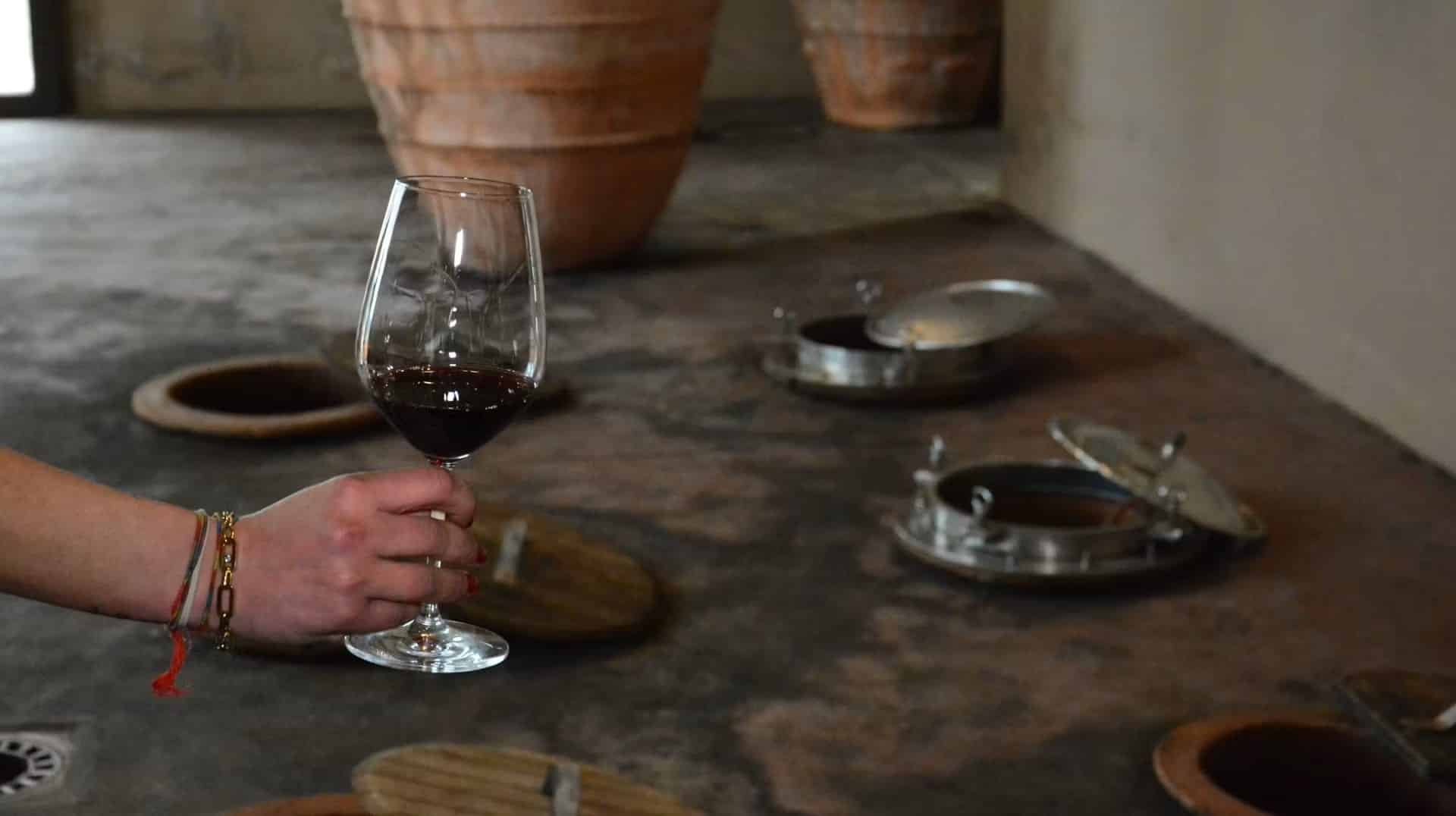
A small portion of the must ferments in underground 1,000-litre terracotta vessels. The rest goes into temperature-controlled steel tanks. Skin contact lasts twenty to twenty-five days. Eighty percent of the wine then ages in steel and twenty percent in second- and third-use barriques, for eight months.
The underground terracotta vessel serves a different purpose here than in the De’ Pazzi. In Sardinia’s inland, where summers run hot, and temperature swings are wide, the ground itself provides passive climate control. At sufficient depth, soil temperature stabilises around fourteen to sixteen degrees Celsius.
The mass of the clay and the insulating effect of the surrounding earth dampen the temperature spikes that can disrupt fermentation in above-ground steel tanks. Active cooling becomes largely unnecessary as a result. The principle echoes the Georgian qvevri: a buried vessel that benefits thermally from the surrounding soil. At Olianas, that same technique supports a wine that is otherwise raised with restraint.
The Sogno as a triangle of cement, terracotta, and barrique
The Sogno Mediterraneo 2022 Toscana IGT from Tenuta Casadei adds a third material to the mix. The wine blends 85% Syrah with 15% Mediterranean dark-skinned varieties, from vineyards near Suvereto on the Tuscan coast.
After harvest, the grapes are cooled for 24 hours at 10 °C. Crushing and spontaneous fermentation follow in cement, partly supplemented by terracotta vessels. Maceration runs eighteen days. Once the wine is drawn off, malolactic fermentation takes place in barriques. The wine then ages twelve to fourteen months: eighty percent in second-use French barriques, twenty percent in new French oak.
Cement and terracotta both release few recognisable aromas, though both can allow some oxygen exchange. How much depends heavily on vessel construction, wall thickness, composition, and coating; the material name alone doesn’t establish a fixed ranking.
That sequence carries a clear technical logic. During fermentation, the focus sits on the fruit, the extraction, the texture. The barriques that follow add measured oxygen exposure and oak character. In the glass: blackberry, blackcurrant, dark chocolate, tobacco, soft tannins, and length. Powerful, but agile.
How terracotta began at Casadei
Around 2011, Stefano Casadei introduced terracotta vessels across all three estates. The catalyst was a project in Azerbaijan, near the Georgian border, where he encountered the Georgian qvevri tradition. The impression stuck firmly enough to translate the principle to Tuscany and Sardinia, initially as a component: a fraction of a blend, meant to add fruit and freshness.
That changed because of their daughter, Elena.
As Anna Baj Macario told the tasting, Elena left her engineering studies in Pisa after six months. Stefano was furious. His response, in Anna’s words: ‘If you’re quitting your studies, you’re working in the cellar.’
As a newcomer, she was handed the terracotta vessels. After a year or two, she asked why all that work kept disappearing into other wines. Could it become a project of its own?
That’s how Le Anfore di Elena Casadei came about: wines fermented and raised entirely in terracotta, with long macerations in Tuscan Impruneta clay vessels and Georgian qvevri. White and red, drawn from across the family’s different estates.
Three of the four red wines in this tasting show how Famiglia Casadei deploys terracotta within its more accessible wines: a fraction here, a partial fermentation there. Cautious, understandably so, given that the public needs to follow along, and the production still needs to pay for itself. At the same time, terracotta functions at this company as both a radical instrument and a routine technical tool within standard blends.
That partial use is exactly what makes it interesting. Full vinification in terracotta can easily turn into a style statement. A winemaker who runs twelve percent of a final blend through terracotta uses the material with far more precision: as a tool, not a doctrine. My initial scepticism on that point turned out to be premature.
Where BioIntegrale becomes tangible
Within the familiar combination of steel, cement, and wood, Casadei treats terracotta as a genuine fourth option: terracotta as a technological starting point, not a gimmick.
That starting point doesn’t stand apart from the ten-point plan; it’s an extension of it. Anna Baj Macario, co-owner of Castello del Trebbio, described BioIntegrale during the tasting as an ethical framework for the whole team: a tool for anchoring the shift from conventional to organic, and from organic to biodynamic, internally.
Organic, in that sense, is the technique; BioIntegrale is the company narrative that ties soil, hospitality, logistics, and family succession together.
Casadei itself also presents the choice of terracotta as part of that BioIntegrale logic: a revival of older techniques within a philosophy aimed at limiting intervention in both cellar and vineyard.
That’s where the difference from empty sustainability rhetoric shows up. At Casadei, BioIntegrale isn’t only a manifesto; it also produces a tool that actually works in the cellar. The terracotta vessels at Casadei deserve a bigger role in how the company presents itself, and the technical choices behind these wines deserve a far bigger place in its story. I say that as someone who drank all four red wines with real pleasure, and who, afterward, might still have preferred to open one from Elena’s Le Anfore line instead.
The most original story at Famiglia Casadei sits in the cellar, in the spot where clay stands alongside steel, cement, and oak. Terracotta forms its own category there: it can allow limited oxygen exposure, releases far fewer recognisable vessel aromas than new oak, and, especially when buried, can dampen temperature swings.
Oenological literature now treats terracotta as a serious alternative to stainless steel, wood, and concrete, with properties such as oxygen permeability, porosity, and influence on wine development under systematic study.1
Casadei uses that tool with care, in modest fractions alongside familiar materials. That’s exactly where the originality lies: terracotta as a deliberate intervention in the vinification, rather than a flashy style statement. That story deserves a far bigger place in how the company presents itself, and it’s precisely the story I’d have liked to explore further during the tasting. Perhaps that chance will still come.
All images courtesy of Famiglia Casadei.
Footnotes
- Esoyan, S., Loupiac, C., Hovhannisyan, N., Gougeon, R., Karbowiak, T., Michalke, B., Schmitt-Kopplin, P., Fontaine, C., Valange, S., & Bodart, P. R. (2023). Interaction between Armenian clay-based ceramics and model wine during storage. OENO One, 57(2), 101–113. https://doi.org/10.20870/oeno-one.2023.57.2.7243 ↩
This article first appeared in Dutch on Winecastr.com: Het kleiverhaal dat Casadei nog niet vertelt
Last updated: 22 September 2026