
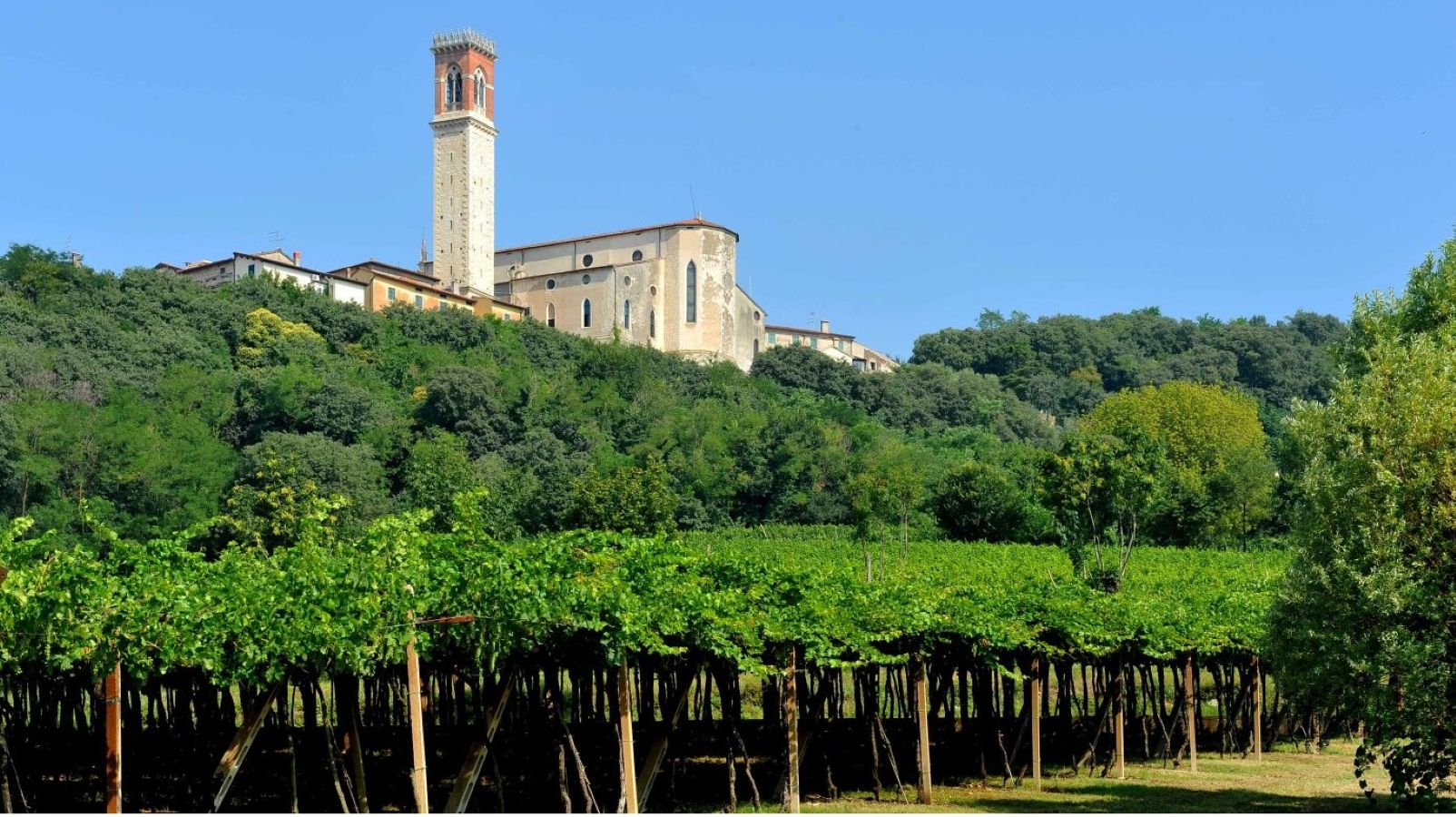
Fresher, less concentrated and ideally lower in alcohol: that is why Colli Berici is giving the traditional pergola more room again. The DOC in Italy’s Veneto is even changing its rules to make it happen.
Shade is the obvious answer to heat. A vine-covered pergola blocks direct sunlight while air keeps moving between the leaves. You can sit under it, eat under it or park a car under it. Vines are practical: in summer they provide leaves and shade, in winter they are bare. A heavy fall of snow then has far less to settle on.
In viticulture, the same principle works on a larger scale. On a pergola, the bunches hang beneath a canopy of leaves, whereas vertical training systems expose them far more directly to the sun. Under that canopy, the berries receive less direct sunlight, peak temperatures stay lower and the development of acids, sugars, and aromas changes.
Colli Berici makes room for the pergola again
In Colli Berici in Veneto, the Consorzio Tutela Vini Colli Berici e Vicenza wants to allow the pergola for new plantings and replantings on slopes for all grape varieties within the DOC. Until now, that option applied mainly to Garganega. At the time of writing, the final ministerial decree had not yet been published. According to director Giovanni Ponchia, the consortium was only waiting for that decision.
Under the old rules, a grower replanting a vineyard parcel previously trained on pergolas sometimes had to switch to a vertical training system. According to Ponchia, that restriction disappears once the rules change, and growers can choose the pergola again.
‘The main goal is to provide wineries with more options’, Ponchia writes in an email to Winecastr. In his view, the pergola has proven its worth in preserving acidity. In the current market, he also sees wines with lower alcohol as an advantage.
What happens under the canopy?
In vertical training systems, shoots usually grow upwards between wires. VSP, Vertical Shoot Positioning, is one such vertical canopy. Guyot is a pruning method often combined with it. On a pergola, the shoots run horizontally or at an angle above the grapes. The bunches hang beneath the canopy.
A study by Fabrizio Battista et al. (2014)) in Valpolicella compared Guyot-trained Corvina with the same red grape under pergola. The denser canopy blocked more sunlight. The berries stayed cooler and contained more tartaric acid. Sugar levels barely differed.
On hot days, the temperature gap widened considerably. In the Guyot vineyard, about half of the bunches hung in direct sunlight. There, the researchers measured berry temperatures that on some days exceeded air temperature by more than 10 °C. Under the pergola, the berries stayed cooler.
Higher acidity, roughly the same sugar levels
With the white grape Erbaluce in Piedmont, Federico Bonino and Marco Bovio found something similar at harvest. Grapes from the pergola had higher total acidity and a lower pH than grapes from VSP. The difference in °Brix was not statistically significant.
Ponchia expects the pergola to deliver ‘higher acidity, more floral notes, less alcohol, and less concentration’. In both the Corvina and the Erbaluce studies, sugar levels remained roughly equal. The research therefore mainly supports his expectation of higher acidity. Lower alcohol does not automatically follow.
Grape variety and harvest date largely determine how much sugar the grapes contain. In dry wine, practically all sugar ferments into alcohol. In sweet wine, the winemaker stops fermentation earlier and some sugar remains. Higher acidity on its own says little about the final alcohol level.
For the consumer, what happens in the glass is what counts. Higher acidity gives a wine more freshness and tension. A wine does not need a lower alcohol percentage for that.
Red wine is losing ground
Global consumption of red wine is falling. According to the OIV, it stood at 112 million hectolitres in 2021, 15 per cent below the 2007 peak. France, Germany, Italy and Spain in particular drank less red.
White wine rose from about 91 to 100 million hectolitres between 2000 and 2021. Rosé grew from about 20 to 23 million hectolitres. So white wine did not just gain market share because red shrank; people actually drank more of it. The latest OIV breakdown by colour runs to 2021.
Meanwhile, total wine consumption is declining. In 2025 it came to 208 million hectolitres, 2.7 per cent less than a year earlier and 14 per cent below 2018.
IWSR sees white and rosé wines outperforming red, and links this to demand for lighter, fresher taste profiles. At the same time, the research firm expects the global decline in wine volumes to continue. Between 2019 and 2024, the volume of still and sparkling wine shrank by 15 per cent.
Ponchia sees the same preference in Colli Berici, in ‘lower alcohol content, interpretations of the red Tai more lightly colored and greater attention to fruitiness and freshness’. He adds that white wines from the Berici hills have also performed well. They account for about a third of production.
More freedom in the bottle
The new rules in Colli Berici go beyond the pergola. For Colli Berici Rosso and Bianco, producers also gain more freedom in the proportions of the permitted grape varieties.
Ponchia links this to vintage variation. Each grape variety, he says, responds differently every year. Fixed minimum and maximum percentages then limit the winemaker’s room to manoeuvre. ‘This allows producers to focus more on the wine’s profile rather than on minimum and maximum percentages.’
According to him, this also shifts attention towards terroir and away from the individual grape variety. That stands out in an appellation that has built much of its identity around Tai Rosso, the local name for Grenache, and Carmenère. In April, I attended an online tasting of Colli Berici organised by Studio Cru, at which Ponchia presented the appellation on behalf of the consortium. My earlier article on Colli Berici focused largely on precisely those two grapes.
Elsewhere, the pergola never left
In Valpolicella, the pergola never disappeared. According to the consortium, about 75 per cent of the vines still grow on pergolas. The rest is Guyot. The canopy protects the grapes from direct sunlight.
On the Atlantic coast of Galicia, in north-western Spain just above Portugal, the high parra serves a different purpose. In Rías Baixas, Albariño vines are often trained up to about two metres high. The DO cites rain, humidity and fungal disease as the main reasons for using pergolas. Air moves under the canopy, and the bunches hang further from the damp soil.
Historically, the space beneath pergolas had a purpose too. Families grew vegetables and other crops there. The DO Rías Baixas explicitly names that use as part of the traditional parra.
Vitiforestry in Piedmont
In Piedmont, livestock also found room under the pergolas. At a winery studied in Settimo Vittone and Carema, Barégeoise sheep have grazed between the vines since 2010. They are there mainly in April and May, and again from October to December. The rest of the year, they graze on surrounding pastures. The small breed stays below the leaves and bunches, keeps the grass short and fertilises the soil.
Sheep, incidentally, love grapes. According to a common explanation, the Italian grape Pecorino even owes its name to them. Pecora means sheep; migrating flocks are said to have nibbled the early-ripening grapes along the way.
Bianca Maria Seardo classes such combinations as vitiforestry: viticulture within a mixed farming system that includes, for example, other crops, grassland, trees or grazing. In her paper for the 2024 OIV congress, she calls this ‘innovative heritage’: agricultural heritage that gains new meaning in climate adaptation.
Even higher: Bellussera
Veneto has another high-trained vine system: Bellussera. In that system, vines run diagonally outwards from tall posts. It is more open than a pergola and likewise left room for other crops beneath the vines. I wrote about it earlier as ‘the vineyard that hangs in the air’.
A dense canopy has a downside
A pergola requires careful canopy management. Too much foliage blocks plenty of sun, but it also slows air movement around the bunches. In a humid climate, leaves and grapes then stay wet for longer and fungal disease pressure rises.
In Rías Baixas, leaf removal and shoot positioning therefore remain important. Espaldera, a vertical training system in which shoots grow upwards along wires, is also used within the DO, mainly on higher, drier plots and where mechanisation plays a bigger role.
Grape variety matters as well. A vigorous variety with abundant foliage demands more pruning than one with more modest vegetative growth.
Frost, hail and hot soil
The height of the bunches also matters in frost, hail, and heat. In radiation frost, when soil and plants cool sharply during a clear, still night, the coldest air collects just above the ground. Buds and young shoots higher up in the vineyard then often stay slightly warmer. In advective frost, wind brings in a large mass of cold air. In that case, having buds and shoots higher above the ground barely helps.
In a hailstorm, the canopy intercepts some hailstones. How much it catches depends on leaf density, wind direction and the size of the hailstones. A pergola is therefore no hail net.
Height above the soil also matters on hot days. The canopy keeps sun off the ground as well. As a result, the soil heats up less and radiates less heat back to the grapes. The bunches also hang higher above the ground and out of direct sunlight.
Labour remains the weak spot
Vertical training systems gained ground in the twentieth century because they made mechanisation much simpler. Pruning, canopy management, crop protection and harvesting are easier with tractors and machines. On a pergola, much of the work is done above your head. After a few hours, you feel it in your arms and shoulders.
In the Erbaluce study, establishing VSP cost more, mainly because of the higher planting density. After establishment, VSP required less labour. Winter pruning took about half the effort, and canopy management about twenty per cent less.
Ponchia does not expect a rapid shift in Colli Berici either. ‘In our sector, changes unfold over years’, he writes. He does say some wineries are about to replant vineyards and will now choose pergola training.
In the end, the difference is in the bottle
For the consumer, what ends up in the glass is what counts. A wine at 13.5 per cent alcohol can taste fresh and light, while another at the same percentage comes across as much heavier. Acidity, fruit, concentration, and tannin together determine that difference.
Ponchia expects the pergola to bring higher acidity, more floral aromas, less concentration and lower alcohol. The last of these in particular is not yet established. The Corvina and Erbaluce studies show that grapes under the pergola retained higher acidity, while sugar levels stayed roughly the same.
With Tai Rosso, Ponchia already sees lighter colours and more attention to fruit and freshness. Some producers are now replanting and choosing pergola training again. Those new vineyards still have to come into production. It will therefore take years before the effect of the pergola on the wines of Colli Berici becomes clear.
Perhaps at home too?
Outside the vineyard, the principle is simpler. A vine-covered pergola shades a terrace, a paved area or a parked car. Japanese researchers compared parking spaces in full sun with spaces under a wisteria-covered pergola. In full sun, dashboard temperatures rose above 70 °C. Under the canopy, the dashboard stayed about 10 °C above outside air temperature.
Deciduous climbers have a practical advantage here. Grapevines, wisteria and deciduous species of clematis and honeysuckle provide shade in summer and let light through again in winter. Ivy stays green and therefore catches wind and snow in winter as well. The structure must be strong enough for the weight of the plant and the loads imposed by rain, wind and heavy snow.
Image: © Consorzio Tutela Vini Colli Berici e Vicenza, via Studio Cru
This article was first published in Dutch on Winecastr.com. The English version was translated with AI support and checked before publication.